Unique Insights Into The Deities Of India
Varuna: Primordial Cosmic Ocean
Discover Life Travel
The God Who Bound the Stars
Varuna stands as the earliest named sovereign in Vedic religion, his Sanskrit root "vṛ" meaning to encompass or cover, a title fitting the deity whose dominion stretched over sky, sea, and the invisible law holding both in place. He appears more than three hundred times in the Rigveda, composed roughly between 1500 and 1200 BCE, and hymn seven addresses him as king of both gods and mortals. Seers of the Angirasa lineage, particularly Vasishtha, composed his principal praises, and the god answers with an intimacy absent from other deities of the age. He owned a thousand-mile rope, the danda, a cord he tied around any mortal who spoke falsely against the cosmic order. Varuna Primordial Cosmic Ocean
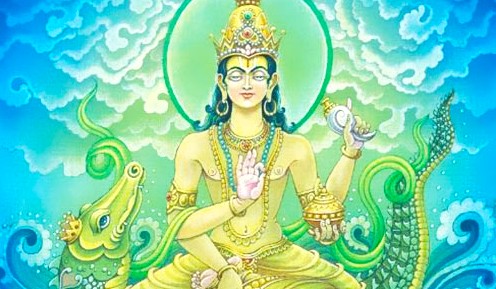
Varuna: Primordial Cosmic Ocean
Scholars trace Varuna to the Indo-Iranian period, where the Avesta preserves Vourukaşa, a vast sea surrounding the world, and the compound Asura Varuna matches the Avestan Ahura Mazda in title. Georges Dumézil proposed in his 1934 study Mitra-Varuna that the god belonged to a dual sovereignty system alongside Mitra, Varuna exercising terrifying magical authority while Mitra administered contract and law. The proto-Indo-European stratum behind this pairing may reach past 3000 BCE, making the god's identity one of the oldest reconstructible in any mythology. His name survives in the names of communities and rivers across north India, echoing a divine figure worshipped before temples existed anywhere on the subcontinent.
The Watcher With a Thousand Eyes
Varuna's defining quality was surveillance. The Rigveda describes him with a thousand eyes, watching every deed, and hymns record mortals begging release from cords he fastened upon liars, gamblers, and oath-breakers. Sin against him, called enas, was a bond requiring release through confession and offering. Magicians of the Vasishtha school performed rites on his behalf, and the Atharvaveda, compiled near 1000 BCE, preserves spells asking the god to untie the knot of sickness and guilt. His spies, the Varuna-purusha, were said to walk among humans counting their transgressions. The famous dialogue hymn of Vasishtha records the seer pleading blindness before the god and receiving pardon. Varuna Primordial Cosmic Ocean
The Golden Palace Above the Waters
Textual descriptions place Varuna's residence in a golden hall of a thousand pillars located at Rasatala, beneath the western ocean, where the sun entered the underworld at dusk. He commanded the waters, apas, personified as goddesses who flowed from the sky and healed through their touch. The Shatapatha Brahmana, dated near 800 BCE, names him lord of all streams and tells how the river goddesses carried him. His court included the Adityas, the sons of Aditi, among them Mitra, Aryaman, and Bhaga, each governing a facet of cosmic law. The god rode a sea creature called Makara in later iconography and carried a pasha, his binding noose. Varuna Primordial Cosmic Ocean
The Soma Rite of Kings
Varuna anchored the Rajasuya ceremony, the Vedic royal consecration dated in its textual form before 800 BCE, where a candidate for kingship drank soma in his honour to assume divine sovereignty on earth. Priests of the Vasishtha lineage officiated, chanting verses comparing the king to Varuna's own majesty. Sacrifices offered to him required white offerings, milk poured at night, and strict truthfulness from every participant, since a single lie during the ritual voided the entire ceremony. The Taittiriya Samhita prescribes a hundred and eight libations for restoring the god's favour, quantities recorded in exact measure and distributed among the priestly ranks performing the rite. Varuna Primordial Cosmic Ocean
The Vasishtha Connection
Rigvedic book seven belongs to the Vasishtha family of seers, and it contains the largest concentration of Varuna hymns, suggesting hereditary patronage between the god and this priestly lineage. Vasishtha, one of the seven great rishis, is named in the Mahabharata as Varuna's own priest, and the epic's Adi Parva records the story where the god granted the sage a divine cow and a celestial chariot. The Vasishtha gotra, a lineage still traced among Brahmin families across north India, counts the god as its patron deity. Their descendants carried his liturgy forward for centuries, and grant inscriptions from the Gupta period onward invoke him before royal signatures.
Sovereignty Lost to Indra
The decline of Varuna's rank is charted precisely in Vedic literature itself. In the Rigveda's earliest books he stands supreme; by the later tenth book, Indra, the storm king and warrior god, receives more hymns and greater honours. The Shatapatha Brahmana openly tells how Varuna was pushed from dominion over heaven into dominion over water alone, a mythic record of a real theological shift. Scholars date this transformation between 1200 and 900 BCE, coinciding with a social change from herder-chiefs toward warrior aristocracies in the Kuru kingdom, where martial values favoured Indra's violence over Varuna's juridical silence. The old god retreated to the sea.
Renamed in the Puranic Age
Between 300 and 900 CE, the Puranas rewrote Varuna's biography entirely. The Vishnu Purana and Bhagavata Purana demote him to dikpala, guardian of the western direction, one of eight regional wardens ranked far beneath Shiva, Vishnu, and Brahma. The Mahabharata's Anushasana Parva, near 400 BCE in its compiled form, preserves stories where the god tests Yudhishthira and supplies the snake-sacrifice that frames the epic itself. His thousand eyes became a description of the stars, and his noose transferred to Yama, the death god. What had been the highest name in prayer became a ministerial post in a crowded divine administration. Varuna Primordial Cosmic Ocean
Worship and Its Measured Offerings
Ritual quantities for Varuna appear in the Brahmana texts with exact figures. The Varuna-sava ceremony prescribed offerings of curd, clarified butter, and rice boiled in milk, a hundred and eight ladles distributed at midnight while reciting his secret names. Worshippers wore white, the god's colour, and avoided salt on ritual days. Temple worship, once available to him in scattered shrines, contracted to a handful of coastal sites where fishing communities honored him before voyages. A famous Naga image recovered near Varanasi, dated to the first century BCE, carries an inscription naming the god, among the earliest physical evidence of his cult anywhere in north India.
The God in Story and Sea
Narrative literature preserved Varuna through anecdote. The Ramayana, compiled near 300 BCE, records Rama praying to the god for three days before the sea granted passage to Lanka, a story repeated at coastal shrines. The Agni Purana lists his iconography, a red-skinned figure on a crocodile bearing a noose and lotus. Tamil Sangam poetry of the early centuries CE knew him as a lord of rain, and the god absorbed attributes of the weather deity in southern tradition. Fishermen of the Konkan coast kept vows to him before monsoon voyages, a practice recorded by British administrators in the 1830s.
Families of the God's Circle
Varuna's own household appears in genealogical chapters of the Mahabharata and Puranas. His wife Varuni, goddess of wine, emerged from the churning of the ocean when the gods and demons churned the cosmic sea, a myth dated in textual form before 400 BCE. His son Pushkara and his daughter, the river goddess Ganga in some accounts, married mortal kings in stories that linked divine and human genealogies. The Bhagiratha narrative, where that king persuades the god to release Ganga to earth, connects the deity to the sacred river's descent myth. These marriages wove Varuna into every major divine lineage of the age. Varuna Primordial Cosmic Ocean
Where the Old God Survives Today
Current practice keeps faint traces of the former sovereign. He is invoked in Sanskrit wedding mantras, in funeral rites where water is offered for the dead, and in the kalasha, the pot of water placed at Hindu ceremonies, whose presiding deity is Varuna by ancient prescription. Astrologers assign him rulership of the direction west in modern panchang calendars. The Indian navy launched a warship named after the god, and coastal temples from Gujarat to Kerala maintain his shrine among the eight guardians. The hymns of Vasishtha remain in print and recitation, and scholars at Indian universities still publish critical editions of the Rigveda books where his voice is loudest.
The Lesson of His Long Retreat
Varuna's trajectory through three thousand years of text offers the clearest documented case of a supreme god's rank receding while his functions survived. The moral authority that once bound kings dissolved into liturgy, the noose became a metaphor, the golden palace faded into directional geography, and the god who once commanded the universe ended as the keeper of a pot of ceremonial water. Yet his earliest hymns still speak across the gap with unusual tenderness, a seer confessing his faults to a fatherly judge, and the confession still reads as one of the oldest recorded acts of conscience in human literature. Varuna Primordial Cosmic Ocean
Step Inside The Story - View All Tour Itineraries & Details

We’re here to offer genuine, thoughtful guidance if your interested in travelling to India. As a small, dedicated team, we pay close attention to every detail so you can focus on enjoying the experience while we take care of the planning. We believe the best trips begin when someone truly listens to what you want and how you like to travel, so the journey feels right for you and contributes to a happy, positive group on tour. Our communication stays clear, straightforward, and respectful at every step, with the goal of helping you feel understood, supported, and confident from first contact to the end of your journey.
Click Catherine Frith - About The Founder
Click Discover Life Travel - All Tours and More
Click Why We Are Different - Unique, Safe, Transparent