Desert odyssey tour Rajasthan india
Bikaner Miniature arts Rajasthan
Mother Masala Tours
Squirrel-Hair Brushes and Stone Colours
Bikaner means “settlement of Bika,” named for Rao Bika, the Rathore prince who founded the city in 1488. Its painting tradition, called laghu chitra, meaning “small picture,” is set in northwestern Rajasthan. Raja Rai Singh, a general of Akbar, began the fort in 1589 and opened the door to Mughal taste. Karan Singh set up a formal workshop and hired Ustad Ali Raza of Delhi around 1650. Anup Singh brought Deccani manuscripts and painters home, and Ruknuddin led the studio. By the mid-eighteenth century, artists opened commercial studios. Today, in a city of about 644,000, Mahaveer Swami continues the style. Bikaner Miniature arts Rajasthan
Bikaner Miniature arts Rajasthan: Timeless Artifacts
Three records carry the story. Ali Raza’s Vaikuntha Darshana, from about 1650, is held in the Bharat Kala Bhavan in Varanasi, and Nuruddin’s Krishna Swinging and Radha in Sad Mood, dated 1683, belongs to the National Museum in Delhi. The reverse of a folio carries inscriptions, mainly in Marwari and sometimes in Persian, naming the artist, the date and at times the occasion. Royal account diaries called bahis add a substantial paper trail, which makes this the best documented of the Rajput schools. Painters also decorated doors, furniture and goddess statues located in the fort, so the notable work reaches beyond paper, and every surviving signature is an important clue.
Ancient Mosaics: Impeccable Craftsmanship
Each painting passed through many hands in the Mandi workshop. Junior apprentices prepared layered wasli paper and ground the pigments, intermediate students drew the sketch and laid the base, and the master finished the faces in chehra kushai, then lifted the whole work to unity in gudarayi. Ustad Ali Raza arrived around 1650. Ruknuddin painted Ladies’ Party about 1665, and Nathu painted Lady Looking into a Mirror in 1665. Ibrahim, active from 1675 to 1700, perfected misty skies and slender figures, and Nuruddin dated his Krishna Swinging in 1683. The refined, elegant, delicate composition shows exquisite artistry and sophisticated colour, and the school kept that look into the nineteenth century. Bikaner Miniature arts Rajasthan
The Pulse of the Local Community
Two painter groups shaped this art. The Ustas, hereditary painters trained in imperial workshops, brought portraiture and realistic drawing, while the Matherans, home-grown Hindu painters and Jain ascetics, specialised in religious icons, manuscript illustration and temple frescoes. From the mid-eighteenth century the Lalani and Swami families championed new subjects. Mahaveer Swami, born in 1959, works in a studio about 300 years old and collects natural colours all year. Shivkumar Swami describes finishing a miniature in three to four days, with a younger brother in training. Daily activity stays relaxed yet active, occupied with grinding, drawing and slow drying, and rubbing a rock to reveal colour makes a lively, engaging lesson.
Capturing the Magic: A Photographic Haven
Frame the “rolling” clouds, drawn as dense circular swirls and sometimes edged with gold leaf. Move closer for pointillist foliage, courtyard fountains and animals rendered with near-anatomical care. Slender wrists and half-open eyes mark the school’s faces clearly. In the studio, a rock rubbed to release colour makes a unique, stunning close-up, and a beautiful, fine-pointed brush rests beside impeccable ink lines on the paper.
A Culinary Journey: Savor the Flavour
Every painting begins with a recipe. Colours come from natural rocks, rubbed with water until the shade appears. Layers of handmade paper, pasted together, form wasli, and some artists still use old state stamp paper over a century old because ink behaves well on it. Black ink draws the outlines and pure gold touches the edges of the clouds. Semi-transparent washes called nim qalam give the clothing its cool, restrained look, a classic mark of the school. Squirrel-hair brushes carry the finest lines. Its closeness to Mughal painting, shaped by Deccani lyricism, sets it apart. Together these elements explain why the palette reads far quieter than neighbouring Mewar or Bundi. Bikaner Miniature arts Rajasthan
Festivals of Devotion: Honouring the Sacred and the Divine
Sharad Purnima, also called Raas Purnima, falls on the full-moon night of 25 October 2026, when the tithi runs from 11:55 am on 25 October to 9:41 am on 26 October (IST), and again on 14 October 2027. It remembers the autumn night when Krishna danced the Raas with the gopis of Vrindavan. Bikaner court painters illustrated this Rasalila within the Bhagavata Purana, and the Baramasa series follow the seasons month by month, twelve in all. Radha features in Nuruddin’s 1683 Krishna Swinging and Radha in Sad Mood. The atmosphere is hushed and the mood tender, while energy comes from swirling, gold-edged clouds that keep viewers entranced and feel spellbinding.
The Connection With the Gods
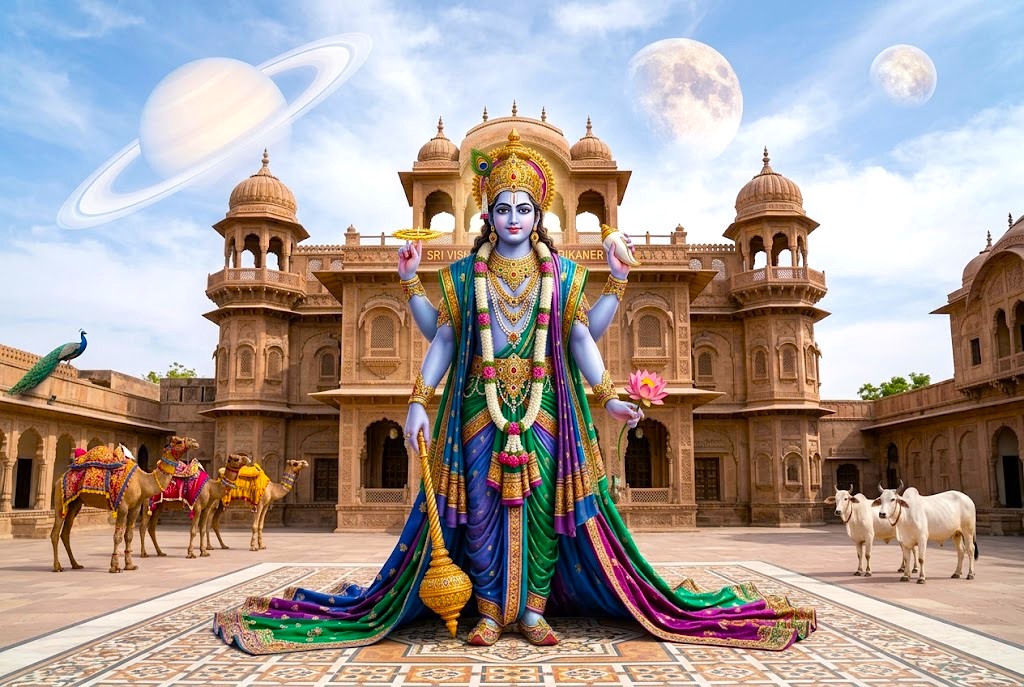
Vishnu and his forms lead the subjects. Ali Raza’s Vaikuntha Darshana, from about 1650, shows a vision of Vishnu’s heaven, and his Lakshmi Narayana joins the deity with Lakshmi. Krishna’s childhood fills Bhagavata Purana folios, including one from 1675 to 1700: sent by King Kamsa, the ogress Putana nursed the infant with poisoned milk, and the child drank her life away. Ruknuddin, the chief painter, painted the Durga Saptashati, where the goddess defeats the buffalo demon Mahishasura, and the Ramayana, which follows Rama, Sita and Lakshmana through fourteen years of exile. The feeling is peaceful, the stories mystical and the effect magical, a meaningful tie between worship and the brush.
Ancient Technologies: Sacred Sound, Geometry & Astrological Influences
Healing practitioners cite six Solfeggio frequencies: 396, 417, 528, 639, 741 and 852 Hz, linking 528 Hz with calm and renewal, though proof is lacking. Vibration does draw shape: in 1787 Ernst Chladni showed sand settling into symmetrical formation on a vibrating plate, a phenomenon later called cymatics. Painters met music in Ragamala, turning each musical mode into a picture. Ruknuddin’s symmetrical court-fountain scenes show a full palace edifice, its building design drawn in view, with a balanced composition. Each sheet’s structure rests on layered handmade paper, a framework of fine outlines and mineral pigments, while gold leaf adds reflective elements; careful construction runs from first sketch to final lifting. Bikaner Miniature arts Rajasthan
Serendipitous Meetings: Beyond the Main Path
Walk off a hectic road and a signboard reading Bikaner Miniatures may lead to a studio tucked away behind a doorway, as it did for one writer who called on Shivkumar Swami. He rubbed a coloured rock to show how a shade appears, explained that his shop makes brushes and imports them, and showed stamp paper from the Maharaja’s government, at least a century old. Other painting surfaces include silk, wood and camel hide. Mahaveer Swami’s 300-year-old studio is situated inside his home, where guests can paint a floral motif beside him and buy directly. Swamped by detail in a single sheet, you will want to stay longer than planned.
Resilience and Renewal: Overcoming Adversity’s: Challenges
Painting here survived by changing its shape. Aurangzeb’s reign from 1658 cost many Mughal painters their posts, and under Anup Singh, positioned in the Deccan as a Mughal general, more artists arrived between 1669 and 1698. After the siege of Golconda in 1687, Deccani manuscripts and painters reached the court. By the mid-eighteenth century, shrinking royal treasuries could no longer support large guilds, so artists opened commercial studios and painted Puranic texts and walls for wealthy Jain merchants. Rahim and Chotu served the court in the nineteenth century. Mahaveer Swami later earned a Master Craftsman award in 1986 and a Sanskriti award in 1992, an astonishing, substantial record of persistence.
Urban Legends: Strange Sightings, Myths and Mysteries
Origin tales surround the painters. One account says Raja Rai Singh, impressed at Akbar’s court, brought seven Usta artists home. Another traces the Ustas to Iran, a third to Multan, and a further version says the name comes from the Persian word for master. Shivkumar Swami tells a gentler story about his brushes: a few strands are taken from a squirrel, and the animal is released. He also says one miniature took three months and was accepted by the Guinness Book of Records. The incredible part for many is how a pinch of fur and a rubbed rock make a small miracle, and we stand transfixed at the studio door. Bikaner Miniature arts Rajasthan
Our Adventure Begins, and You’re Invited to Be Part of It
We head first to Mahaveer Swami’s home studio, where you will sit with fine brushes and paint a small floral motif beside him, with time for one-to-one conversation. Then comes the library Anup Singh founded, where Deccani manuscripts explain colour in the paintings. Next we study sumptuous folios and compare the cool washes of the school with luxurious gold edging on the clouds. The luxury here is unhurried time, so we linger over every leaf. Between sessions the pace stays restful, and we sit immersed in colour, mesmerized by the amazing patience behind a miniature that takes three to four days. An energetic final hour of questions closes the visit.
Symphony of Generosity: Offerings from Wanderers to Residents
Both sides gain when a studio opens its door. Guests receive a hands-on painting lesson, an answer to why colours come from rock, and the option to buy a signed original straight from the artist. Original works by Mahaveer Swami are listed at one online gallery for about US$1,970, a guide to the price of a master’s original. Artists receive direct income and an audience for traditional methods on handmade paper, which gives apprentices a reason to learn the craft. Time, patience and curiosity count as gifts too. That fantastic exchange keeps pigments, brushes and knowledge moving from one generation to the next, and every purchase supports a living tradition.
Step Inside The Story - View All Tour Itineraries & Details

We’re here to offer genuine, thoughtful guidance if your interested in travelling to India. As a small, dedicated team, we pay close attention to every detail so you can focus on enjoying the experience while we take care of the planning. We believe the best trips begin when someone truly listens to what you want and how you like to travel, so the journey feels right for you and contributes to a happy, positive group on tour. Our communication stays clear, straightforward, and respectful at every step, with the goal of helping you feel understood, supported, and confident from first contact to the end of your journey.
Click Catherine Frith - About The Founder
Click Discover Life Travel - All Tours and More
Click Why We Are Different - Unique, Safe, Transparent