Unique Insights Into The Deities Of India
Vayu: Primordial Breath of Life
Discover Life Travel
The Primordial Breath of Life
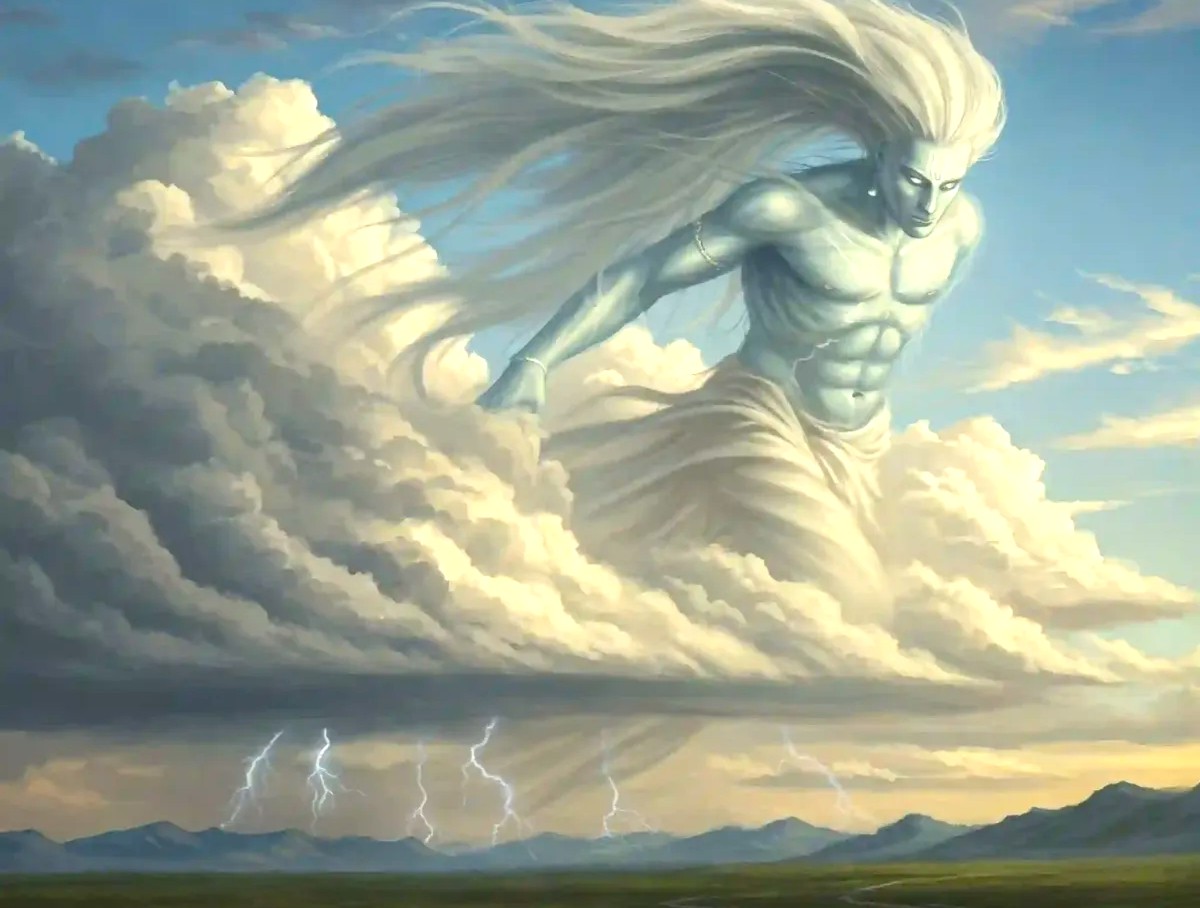
Vayu is one of the most ancient and fundamental deities, a primordial force of nature. The story of his origin as the breath of the cosmos is not one of birth but of eternal existence. He is the Prana, the very life force that animates all living beings. He is the personification of the air and the wind, the invisible yet all-powerful element that fills the universe. His domain is the atmosphere (antariksha), the space between heaven and earth. As a powerful Vedic deity, he is invoked as a protector, a purifier, and the sustainer of life itself, moving through the world from his celestial abode, a constant presence in every breath we take. Vayu Primordial Breath of Life
Vayu Primordial Breath of Life
The symbols associated with Lord Vayu are those of motion, life, and purification. The symbolism of the flag or banner held by Vayu represents his constant movement and his victory over stagnation. The wind itself is his primary symbol, representing change, speed, and the power to clear away impurities. As an unseen force, his spirit is that of freedom, exploration, and boundless energy. He holds a goad in his hand, symbolizing his power to direct the winds and guide the life force within beings. He represents the dynamic, ever-present energy that propels the universe forward and sustains the very fabric of existence.
Father of Two Epic Heroes
Vayu's family lineage is one of immense power and epic significance. He is the divine father of the epic heroes Hanuman and Bhima. Through a divine boon, he fathered the mighty Lord Hanuman, the greatest devotee of Lord Rama, embodying selfless service and limitless strength. In the Mahabharata, he is the spiritual father of Bhima, the second Pandava brother, known for his prodigious physical power and mighty appetite. Vayu's wives are Swasti and Bharati. This paternal role connects the primordial Vedic god directly to the two great epics of India, infusing their strongest heroes with his own elemental power, speed, and life force. Vayu Primordial Breath of Life
A Primordial and Eternal Being
As a fundamental element of creation, Vayu has no childhood in the mortal sense. His "childhood to marriage" is the story of his eternal existence and his role in the cosmic order. The concept of Vayu as an eternal, ever-present deity means he has always existed as the principle of air and movement. His marriage to his consorts represents the union of the life force with blessings and speech, signifying that life itself is a blessing that finds expression. He has always been the king of the winds, a powerful and sometimes tempestuous force, whose journey is the constant and vital movement of breath throughout the cosmos.
The Tale of the Scorpion's Sting
One of the most famous tales illustrates Vayu's immense power and his connection to his son, Hanuman. The story of how Vayu withdrew the air from the world is a powerful lesson. When the child Hanuman was struck down by Indra's thunderbolt for leaping at the sun, a grief-stricken Vayu retreated into a cave, taking all the air in the universe with him. All life began to suffocate. The gods, desperate, pleaded with Vayu. To appease him, they showered boons upon Hanuman, making him immortal and invincible. Only then did Vayu relent and release the breath back into the world, demonstrating his absolute control over life itself.
The Swift and Noble Antelope
Vayu moves with unimaginable speed, and his chosen vehicle reflects this quality. The symbolism of the antelope as Lord Vayu's vahana (vehicle) is perfect for the god of the wind. The antelope is one of the fastest and most agile creatures on land, renowned for its incredible swiftness, alertness, and grace. It represents the ability to move quickly and navigate any terrain with ease. This powerful vehicle symbolizes Vayu's dominion over speed and movement. Vayu himself is the sound of the wind, from a gentle breeze to a howling gale; this cosmic sound is his divine instrument, requiring no physical form. Vayu Primordial Breath of Life
A Battle with the King of Gods
Vayu is a deity of immense power, who once challenged the king of gods himself. The story of the conflict between Vayu and Indra over Mount Meru is a testament to their strength. The sage Narada instigated a contest to see who was more powerful. Vayu unleashed his full might, attempting to blow off the peak of the cosmic mountain, Meru. Indra protected the mountain with his wings. For a year, the contest raged, shaking the cosmos. Finally, at Narada's suggestion, Indra lifted his wing for a moment, and Vayu immediately sheared off the mountain's peak, which flew into the ocean and became the island of Lanka, a victory for the god of wind.
The Eternal Breath of the Cosmos
As a primordial element, Vayu is beyond the cycle of birth and death. The concept of Vayu as an eternal element without death means he is a permanent fixture of the cosmos. He exists as long as creation exists. While his consorts and children are part of the divine play, Vayu himself is the unchanging principle of air and life force. He will only cease to be when the universe undergoes the great dissolution (pralaya), at which point he will merge back into the formless Absolute. Until then, he is the ever-present, immortal breath that flows through every living being, sustaining all. Vayu Primordial Breath of Life
The Message of Constant Motion
The vital message from the Lord of the Wind is to embrace change and remain in motion. The empowering message for humanity from Lord Vayu is that stagnation leads to decay, while movement leads to life and growth. Just as the wind clears away dust and purifies the air, we must constantly clear our minds of negative thoughts and embrace new ideas. He teaches the importance of pranayama (breath control) as a tool for health, vitality, and spiritual progress. Vayu encourages a life of dynamic action, reminding us that every breath is an opportunity for renewal and a connection to the divine life force.
The Heart Chakra and Pranic Energy
Vayu, as the god of breath and life force, is profoundly connected to the body's energy centers. He is the undisputed lord of the Anahata (Heart) Chakra, which is the air element's seat. This chakra governs love, compassion, and our connection to all beings through the shared breath of life. The key frequency that Lord Vayu embodies is Prana, the vital life-force energy. His auric field is a clear or light blue ray, representing space, movement, and purity.
The Irresistible Wind Weapon
As a great Vedic deity, Vayu is the master of a powerful and unstoppable celestial weapon. The story of the Vayuvastra, the celestial weapon of Vayu, describes a missile that could unleash gale-force winds capable of lifting entire armies and scattering them like dust. It was an irresistible force that could clear a path through any obstacle. This powerful weapon was granted to worthy warriors like Arjuna in the Mahabharata. It symbolizes the immense, uncontrollable power of nature, a force that can be harnessed for righteousness by a warrior who has the discipline and wisdom to command it. Vayu Primordial Breath of Life
Astrology of Air and Intellect
Vayu's influence is seen in the astrological elements that govern the mind, communication, and movement. The astrological signs associated with Lord Vayu are the Air signs: Gemini, Libra, and Aquarius. These signs are known for their intellect, communication skills, social nature, and love of freedom. The planet Mercury, the messenger, also shares his qualities of speed and communication. There is no standard sacred geometry for Vayu, as he is formless, but the six-pointed star (hexagram) of the Heart Chakra is his symbolic geometric representation, symbolizing the element of air and the balance between the heavens and the earth.
The Five Vital Bodily Airs
In yogic and Ayurvedic philosophy, Vayu's power within the body is differentiated into five primary functions. The concept of the five Prana Vayus in the body is fundamental to health. These are: Prana (inward-moving air, responsible for inhalation), Apana (downward-moving air, responsible for elimination), Samana (equalizing air, responsible for digestion), Udana (upward-moving air, responsible for speech and exhalation), and Vyana (pervasive air, responsible for circulation). Understanding and balancing these five vital airs through practices like pranayama is key to achieving physical health and spiritual well-being, all under the domain of Lord Vayu. Vayu Primordial Breath of Life
The First Messenger of the Gods
Before deities like Agni and others took on the role, Vayu was a primary messenger. The role of Vayu as a divine messenger in the Vedas was crucial. Moving faster than thought, he could travel between the earthly and celestial realms, carrying messages, prayers, and offerings from humans to the gods. His speed and pervasive nature made him the ideal intermediary. He is a god who is both immanent - present in our every breath - and transcendent, a mighty cosmic force. This dual role as an intimate life-giver and a swift divine messenger highlights his importance in the Vedic pantheon.
A Miracle of a Gentle Breeze
Miracles of Vayu are often subtle yet powerful. A beautiful local experience of Vayu's grace shared by a devotee tells of a farmer in a drought-stricken village in Rajasthan. The crops were failing, and the community was praying for rain. During a special outdoor prayer ceremony, the heat was oppressive, and the air was still and suffocating. An old priest prayed aloud to Vayu, asking him to carry their prayers to Indra, the rain god. As he finished, a sudden, cool breeze swept through the gathering, rustling the dry leaves and bringing immediate relief. That evening, the clouds gathered, and the life-giving rain began to fall.
The King Who Resides Everywhere
Vayu's unique power is his omnipresence. The concept of Vayu's omnipresence as the sustainer of life makes him one of the most intimate deities. While other gods reside in specific heavens or temples, Vayu resides in the space between all things and within every living creature. He is the quiet presence in a still room and the roaring force of a cyclone. This teaches that the divine is not a distant entity but is as close as our own breath. Every inhalation is an acceptance of his divine energy, and every exhalation is a release of what is no longer needed, a constant, life-long exchange with the god of life itself.
A God of Both Storms and Breezes
Vayu's personality is multifaceted, reflecting the dual nature of the wind. He is worshipped as both a gentle, life-giving force and a fierce, destructive power. The dual nature of Vayu as both a gentle and fierce god shows the full spectrum of nature's power. As a gentle breeze, he brings relief, spreads the fragrance of flowers, and carries the seeds of life. As a storm or cyclone, he represents untamable fury, a terrifying force that can uproot trees and destroy structures. This duality reminds devotees to respect the power of nature, to be grateful for its benevolence, and to be prepared for its unpredictable might. Vayu Primordial Breath of Life
Purifier of the Sacred Fire
Vayu has a special and synergistic relationship with Agni, the God of Fire. The relationship between Vayu and Agni, the god of fire, is essential. Fire cannot exist without air. Vayu is the force that stokes the flames of the sacred yajna (fire ritual), making them burn bright and pure. He carries the essence of the offerings heavenward. This symbiotic relationship symbolizes the link between breath and the inner fire of digestion (jatharagni) and the fire of consciousness (chittagni). For a spiritual life to burn brightly, the fuel of a steady, controlled breath is required, highlighting the interconnectedness of these two powerful Vedic deities.
A Test of Strength and Humility
A lesser-known story from the Puranas highlights a moment of Vayu's pride. The story of Vayu's pride and his lesson in humility is instructive. Boasting of his power to uproot any mountain, Vayu was challenged by Sage Narada to move the smallest finger of the child Hanuman. Confident, Vayu unleashed his full power, from a breeze to a hurricane, but he could not move Hanuman's finger even a fraction. Exhausted and humbled, Vayu realized that Hanuman's strength, derived from selfless devotion, was greater than his own elemental might. This taught the powerful god that the force of pure devotion is the greatest power in the universe. Vayu Primordial Breath of Life
A Test of Strength and Humility

We’re here to offer genuine, thoughtful guidance if your interested in travelling to India. As a small, dedicated team, we pay close attention to every detail so you can focus on enjoying the experience while we take care of the planning. We believe the best trips begin when someone truly listens to what you want and how you like to travel, so the journey feels right for you and contributes to a happy, positive group on tour. Our communication stays clear, straightforward, and respectful at every step, with the goal of helping you feel understood, supported, and confident from first contact to the end of your journey.
Click Catherine Frith - About The Founder
Click Discover Life Travel - All Tours and More
Click Why We Are Different - Unique, Safe, Transparent