Unique Insights Into The Deities Of India
Varuna: Primordial Cosmic Ocean
Discover Life Travel
The Eternal Guardian
In the earliest Vedic hymns, before the rise of the Puranic Trimurti, Varuna was a supreme, all-encompassing sovereign god. The divine origin story of the god Varuna places him as one of the elder Adityas, a son of the cosmic mother Aditi and the sage Kashyapa. He was not just a god, but the very personification of the vast, celestial ocean and the overarching sky. He existed as a primordial force, a divine king who established the fundamental laws of the universe. His birth was not a single event, but part of the initial ordering of the cosmos, where he took his place as the supreme ruler and omniscient guardian of cosmic and moral order. Varuna Primordial Lord of the Cosmic Ocean
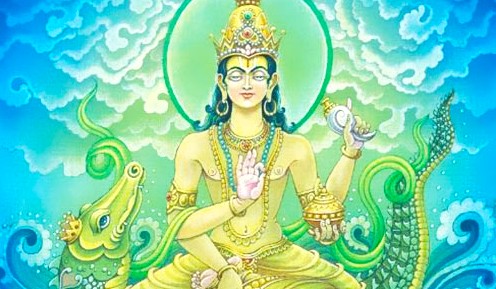
Varuna Primordial Lord of the Cosmic Ocean
Varuna's abode is as vast and profound as his power. In the Vedic era, his location was the entire night sky and the celestial ocean that surrounds the world. From this omnipresent vantage point, he watched over all creation. In later Puranic mythology, as his role shifted, his primary abode became the underwater celestial palace of Nirmochini, located deep within the cosmic ocean. He is also revered as one of the great guardians of the directions, the Ashta-Dikpala who rules over the Western direction. This makes the west, the direction of the setting sun and the great ocean, a sacred space deeply connected to Varuna's divine presence and authority.
The Unescapable Noose of Cosmic Law
The primary symbol of Varuna is a direct and potent emblem of his role as the divine judge and keeper of order. The symbolism of Varuna's divine noose, the Pasha, is central to his identity. This is not a weapon for physical warfare, but an instrument of cosmic law. With this unescapable noose, he binds those who transgress the moral law (dharma) and the cosmic order (Rita). It represents the inescapable consequences of one's actions. He is also often depicted holding a pot of water, representing his dominion over the oceans and the very essence of life, which he can grant or withhold. Varuna Primordial Lord of the Cosmic Ocean
A Divine Family of Water and Wine
Varuna's family is one of primordial power and intoxicating divinity. As a chief Aditya, his brothers include other powerful Vedic gods like Mitra and Indra. His consort is the beautiful goddess Varuni, the personification of divine wine and Soma. In some texts, she emerged from the Churning of the Ocean and chose Varuna as her husband. The divine marriage of Varuna and the goddess Varuni represents the union of the cosmic waters with the intoxicating spirit of divine bliss. His children are equally powerful, including the great Vedic sage Bhrigu, and in some traditions, the goddess of wealth, Lakshmi, is also considered his daughter before she became Vishnu's consort.
The Sovereign King of the Vedic Age
In the golden age of the Vedas, Varuna was the supreme sovereign. The story of Varuna as the supreme Asura king defines his early role. In Vedic Sanskrit, the term 'Asura' originally meant a powerful, divine being, a title Varuna shared with other great gods. He was the Samrat, the universal emperor, who sat on a golden throne and ruled the cosmos with absolute authority. He was not just a king but also the chief priest, upholding the celestial rituals. His "childhood" was this era of supreme power, where his gaze was omniscient and his word was the law that governed the movements of the stars, the seasons, and the moral choices of humanity. Varuna Primordial Lord of the Cosmic Ocean
The Keeper of the Cosmic Order, Rita
Varuna's most important and famous role in the Vedas was as the guardian of a sacred, universal principle. The role of Varuna as the keeper of Rita, the cosmic order, was the foundation of his authority. Rita was the physical and moral law that governed the universe - it was the reason the sun rose, the seasons changed, and rain fell. It was also the moral law that dictated right from wrong. Varuna's primary duty was to maintain this delicate cosmic balance. He was the divine judge who watched over humanity, rewarding the righteous and punishing those whose sinful actions threatened the fabric of Rita.
The Mythical Makara, Lord of the Deep
The vehicle upon which the lord of the waters rides is a creature of immense power, a master of the aquatic realm. The symbolism of the Makara as the divine vehicle of Varuna is deeply significant. The Makara is a formidable composite sea-creature, often depicted with the head of a crocodile or elephant and the body of a fish. It represents the raw, untamed power of the vast ocean and all the mysterious life within it. By riding this powerful beast, Varuna demonstrates his complete and effortless dominion over the oceans, the rivers, and all the waters of the universe, guiding their immense power with his divine will.
The Decline of a Great Vedic God
Varuna's story includes a dramatic shift in the divine hierarchy. The decline of Varuna's status in Hindu mythology is a major theological development. In the Vedas, he was supreme. However, in the later Puranas, the focus shifted. Indra, the heroic warrior god who slew Vritra, rose in prominence, taking over the role of the king of the gods. Later still, the Trimurti of Brahma, Vishnu, and Shiva became the central focus. Varuna was gradually "demoted" from his position as a supreme, all-seeing sky father to the more limited, though still important, role of the god of the oceans and the guardian of the west.
The Divine Judge Who Binds All Sinners
Varuna is not a god to be trifled with; he is the ultimate divine law-keeper. The concept of Varuna as the divine judge of humanity is central to his Vedic character. With his thousand-eyed spies, he was believed to be omniscient, watching every action and even every thought of humankind. He was not a god of easy forgiveness. Those who strayed from the path of Rita - liars, cheats, and the arrogant - were bound by his inescapable Pasha and afflicted with diseases, particularly those related to water, like dropsy. To be "bound by Varuna" was a state of sin and suffering from which one could only be released through sincere prayer, confession, and repentance. Varuna Primordial Lord of the Cosmic Ocean
His Message: Live in Tune with Cosmic Law
Varuna’s ancient message is a powerful call to live a life of truth and integrity. The empowering message from the god Varuna is that the universe operates on a fundamental principle of order and truth, Rita, and that human happiness depends on living in harmony with this law. He teaches that every action has a consequence and that nothing can be hidden from the divine eye. He is a reminder of the importance of personal accountability, honesty, and upholding one's promises. His message is a call to align one's personal conduct with the vast, impersonal, and perfect order of the cosmos.
The Sacral Chakra and a Deep Indigo Ray
As the lord of the cosmic waters, emotions, and the hidden depths, Varuna's energy is connected to the body's fluidic centers. He is a powerful ruler of the Svadhisthana (Sacral) Chakra, the center of the water element, emotions, and the subconscious mind. The key frequency that Varuna embodies is that of cosmic law and the profound, mysterious depths of consciousness. His auric field is a deep, vast indigo or midnight blue ray, representing the night sky, the deep ocean, and his omniscient, all-pervading awareness. Meditating on this color can help one connect with their subconscious, understand deep truths, and align with universal principles. Varuna Primordial Lord of the Cosmic Ocean
The Pasha: The Unavoidable Noose of Karma
Varuna's signature weapon is a unique and terrifying instrument of divine justice. The power of Varuna's Pasha to bind transgressors of Rita is his primary tool of enforcement. This is not a weapon that sheds blood, but one that binds the soul. It is the manifestation of cause and effect, the law of karma made tangible. When a person commits a sin, they are metaphorically "ensnared" by Varuna's noose, leading to suffering and misfortune. The only way to be released from the Pasha is through sincere repentance and a return to a righteous path, making it a weapon that compels moral correction rather than mere physical destruction.
Saturn, the Moon, and the Western Quarter
Varuna’s solemn, judicial, and aquatic nature is reflected in the most profound planetary energies. He is most strongly associated with the planet Saturn (Shani), which governs law, order, justice, consequence, and time. His connection to the ocean, emotions, and the night also links him to the Moon. As the guardian of the West, his influence is strongest in this direction. His sacred geometry is the circle, representing the vast, all-encompassing sky and ocean, and the downward-pointing triangle, the symbol for the water element. Worshiping Varuna is believed to appease Saturn and bring balance to the water element in one's life. Varuna Primordial Lord of the Cosmic Ocean
A Modern Miracle of a Fisherman's Bounty
Even today, those who make their living from the water feel Varuna's direct presence. A modern miracle story from a fishing village in Gujarat tells of a fisherman whose nets had been coming up empty for weeks. Facing debt and starvation, he performed a simple, traditional offering to Varuna at the edge of the sea, praying not for wealth, but simply for the god to show him his grace. That night, he had a dream of a large, dark fish swimming near a specific rocky outcrop. The next morning, he cast his nets in that exact spot and pulled in the single largest catch of his entire life, enough to clear his debts and sustain his family for months. Varuna Primordial Lord of the Cosmic Ocean
The Lord Who Witnesses Every Single Lie
Varuna’s most feared attribute was his absolute omniscience. The Vedic concept of Varuna's omniscience describes a god who knows all. The stars were his spies; he knew every thought in a man's heart. He knew the flight path of every bird and the course of every river. This made him the ultimate god to swear an oath to, as he would be the infallible witness to any falsehood. Oaths were taken in his name, and the fear of his divine retribution was a powerful force for maintaining honesty and social contracts in Vedic society. He was the god who made promises sacred.
Mitra-Varuna: The Divine Partnership of Day and Night
In the Vedas, Varuna is very often invoked as part of a divine pair. The divine duality of Mitra-Varuna represents a complete cosmic government. Varuna was the ruler of the night sky, the cosmic ocean, and the stern, universal law. His brother-deity, Mitra, was the ruler of the day, of friendship, contracts, and social harmony. Together, they formed a perfect partnership. Mitra represented the gentle, benevolent aspect of divine authority, while Varuna represented the strict, judicial aspect. They were two sides of the same sovereign coin, the divine kings who ruled the day and the night, ensuring order at all times.
From Supreme God to Guardian of the West
The story of Varuna's changing status is a fascinating journey through Hindu thought. His evolution from a sovereign deity to a Dikpala reflects the changing needs and focus of the religion. In the early, nature-focused Vedic period, a god who controlled the cosmic laws of sky and water was supreme. In the later Puranic age, which focused more on heroic avatars and personal devotion, the more relatable figures of Vishnu and Shiva rose to prominence. Varuna's power became more specialized, but he was never forgotten. He retained his kingship over the vast and mysterious ocean and took on the eternally respectable role as the guardian of a cardinal direction. Varuna Primordial Lord of the Cosmic Ocean
The God of the Waters and the Rain
In his most enduring form, Varuna is the undisputed king of all bodies of water. The worship of Varuna as the god of oceans and rain is his most common role today. He is prayed to by sailors for safe passage and by farmers for life-giving rain. It is believed that he withholds rain from a sinful kingdom and bestows it upon a righteous one. He is the lord of all aquatic life and the keeper of the treasures - both literal and metaphorical - that lie in the ocean's depths. This role maintains his connection to his Vedic roots as a god who controls a fundamental and life-sustaining force of nature. Varuna Primordial Lord of the Cosmic Ocean
Step Inside The Story - View All Tour Itineraries & Details

We’re here to offer genuine, thoughtful guidance if your interested in travelling to India. As a small, dedicated team, we pay close attention to every detail so you can focus on enjoying the experience while we take care of the planning. We believe the best trips begin when someone truly listens to what you want and how you like to travel, so the journey feels right for you and contributes to a happy, positive group on tour. Our communication stays clear, straightforward, and respectful at every step, with the goal of helping you feel understood, supported, and confident from first contact to the end of your journey.
Click Catherine Frith - About The Founder
Click Discover Life Travel - All Tours and More
Click Why We Are Different - Unique, Safe, Transparent