Unique Insights Into The Gods of India
Brahma: Master of All Creation
Discover Life Travel
The Lotus-Born Cosmic Architect
At the dawn of a new cosmic cycle, before time began, Vishnu lay sleeping on the celestial serpent Shesha in the causal ocean. From his navel, a divine, radiant lotus flower bloomed. The story of Lord Brahma's birth from a lotus in Vishnu's navel is the ultimate tale of creation. As the lotus opened its petals, Brahma appeared, self-born and imbued with the Vedas. Confused by his solitary existence in the vast, dark ocean, he descended the lotus stalk for eons, trying to find its source. Unable to, he returned to the lotus and, through deep meditation, realized his divine purpose: to architect and manifest the entire universe.
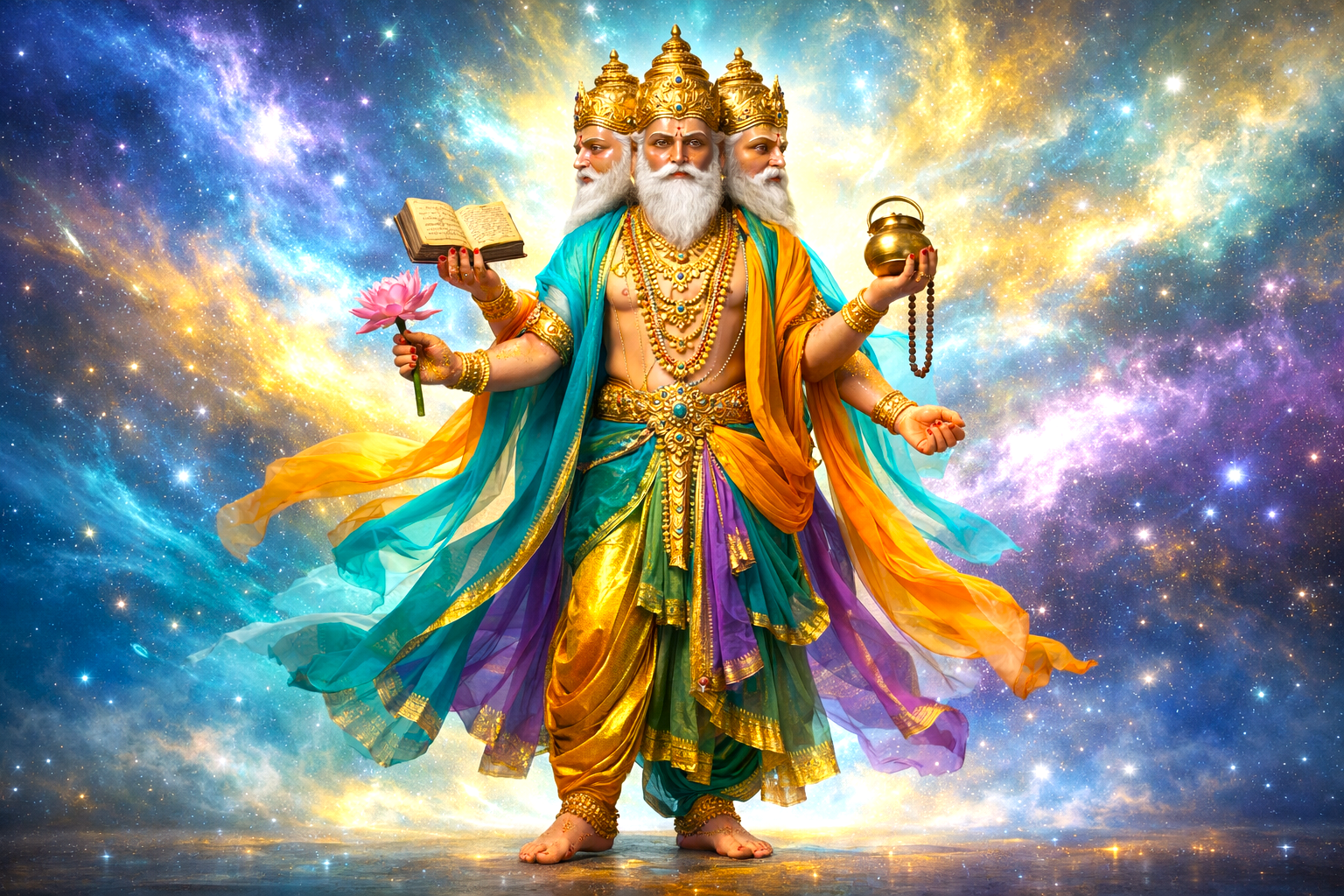
The Four Heads of Creation
Every aspect of Brahma’s form is a profound lesson in cosmic principles. The meaning of Brahma's four heads and their symbolism is central to his identity. The four heads, facing the cardinal directions, represent his creation of the four Vedas (Rig, Yajur, Sama, Atharva), which emerged from each of his mouths. They also signify the four yugas (cosmic ages) and the four varnas (social classes). His white beard denotes his eternal wisdom and status as the great grandsire (Pitamaha). The golden clothes he wears symbolize the active, creative principle, the vibrant energy required to bring the universe into being from the cosmic egg.
The Divine Union of Creation
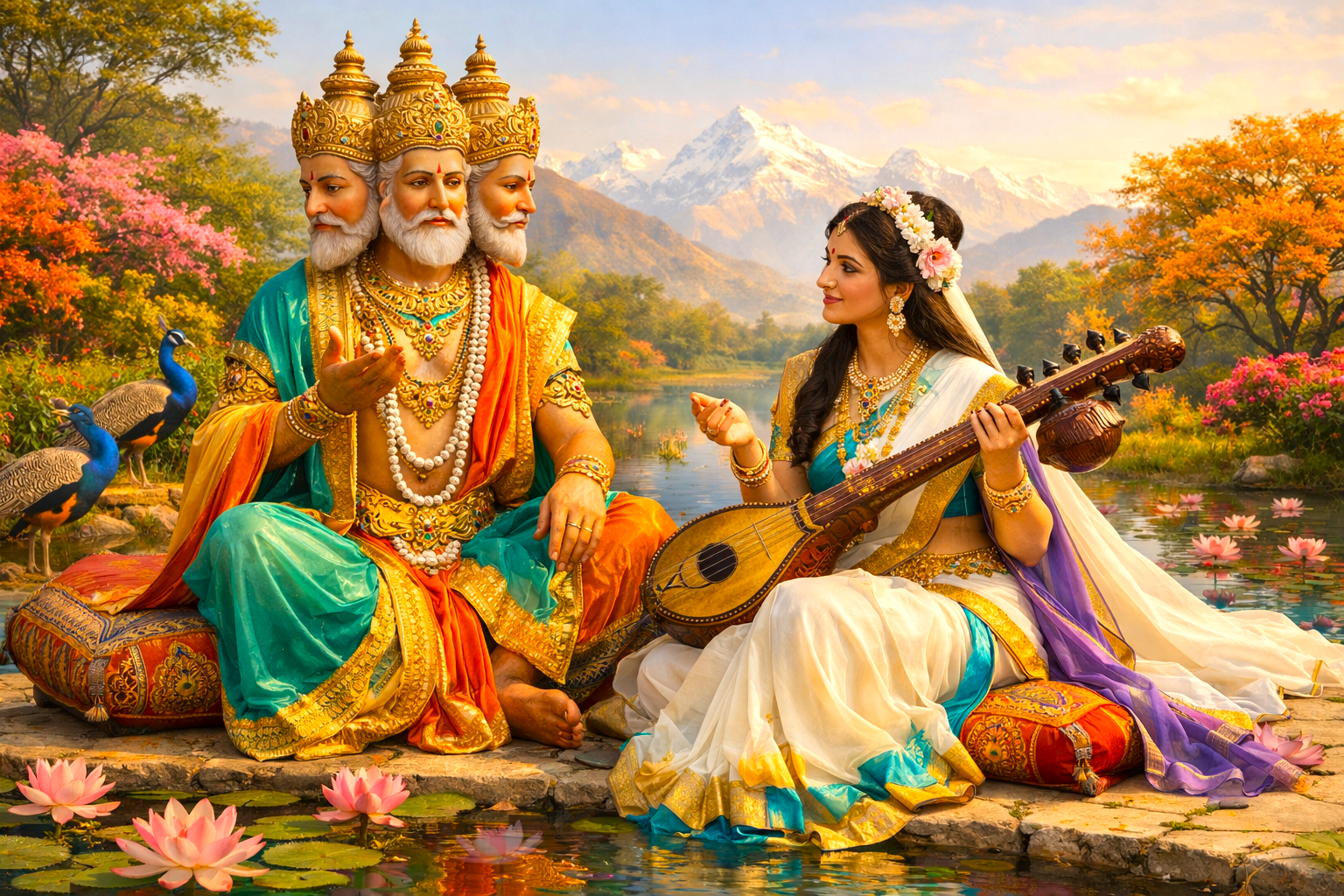
Brahma is the great progenitor, whose family consists of the very forces of knowledge and creation. The family of Brahma and his consort Goddess Saraswati represents the link between creation and wisdom. From his own mind, he created Saraswati, the goddess of knowledge, music, arts, and speech. He realized that to create a meaningful universe, he needed her wisdom. His children are the Manasaputras, mind-born sons like the sages Narada, Daksha, and the Four Kumaras, who were tasked with populating the worlds.
The First Being's Awakening
As the first created being, Brahma did not have a conventional childhood. His "childhood" was his period of awakening to his cosmic purpose. The story of Brahma's journey from confusion to creator is one of self-realization. Alone on the lotus in the primordial ocean, he was initially bewildered. It was only through intense tapas (austerity and meditation) that he gained the vision and power necessary to begin his work. His "marriage" to Saraswati was the moment he unified his creative potential with the divine knowledge required to manifest a structured, meaningful universe. His early life was a journey from solitary existence to becoming the conscious architect of all reality.
The Creator of All Worlds
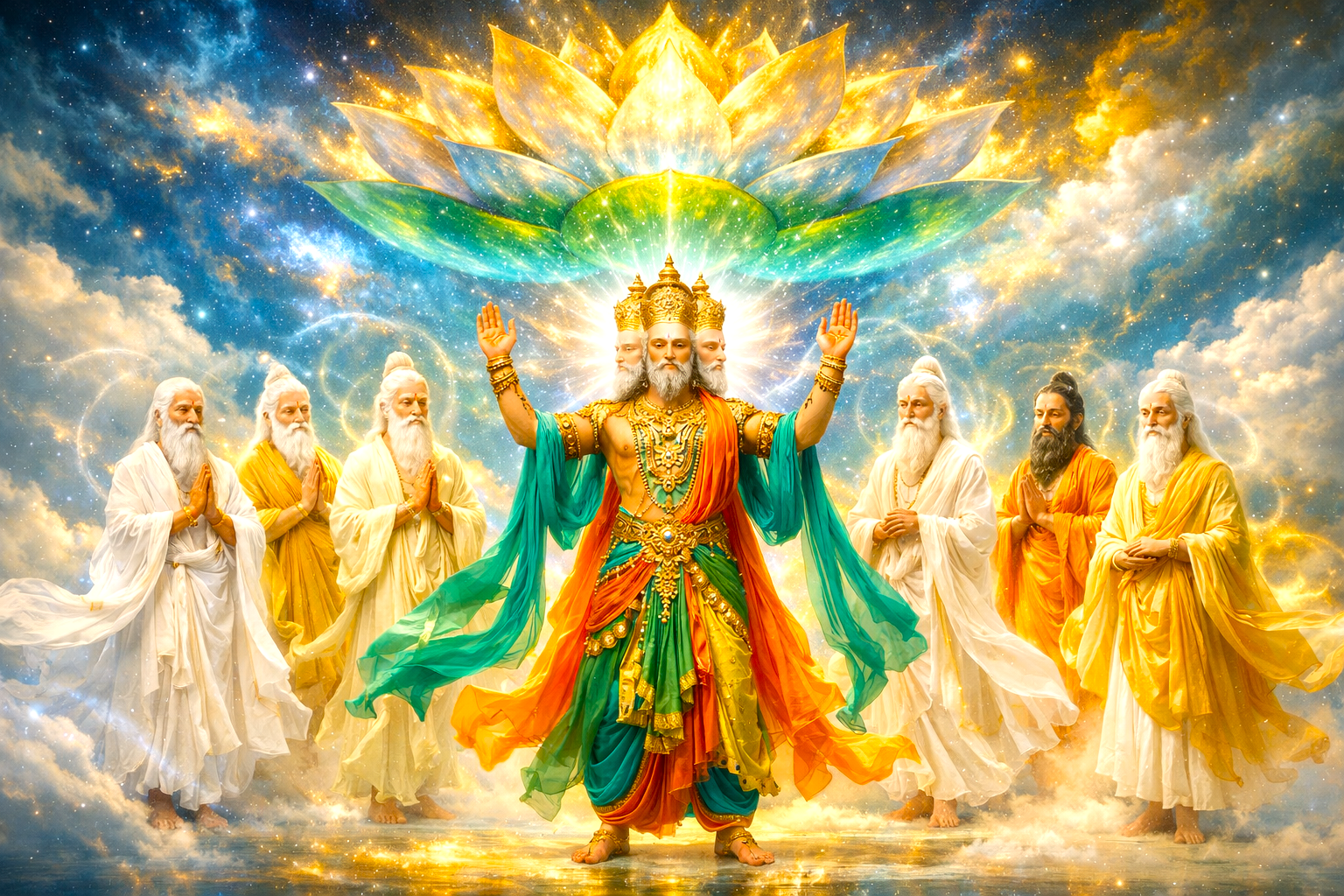
The great story of Brahma is the cosmic manifestation. The story of how Lord Brahma created the universe and all beings is a tale of divine engineering. After meditating and gaining the necessary power, Brahma separated the lotus into three parts: the heavens, the earth, and the sky. He created the sages, his mind-born sons, to assist him. From his body, he created all manner of creatures, plants, mountains, rivers, and the concepts of time, emotion, and duality. He is the divine architect who constructed the material plane.
The Swan of Discerning Wisdom
The vehicle Brahma rides is a symbol of supreme intellectual and spiritual ability. The symbolism of the divine swan or Hamsa as Brahma's vehicle is deeply profound. The mythical hamsa possesses a unique and magical ability called neera-ksheera viveka - the power to separate pure milk from a mixture of milk and water. This represents the essential quality of a wise being: the ability to discern truth from falsehood, reality from illusion, and the eternal from the transient. Riding the swan signifies that the act of creation is guided by this supreme discriminative wisdom, ensuring that the universe is built on a foundation of truth.
A Creator Beyond Earthly Wars
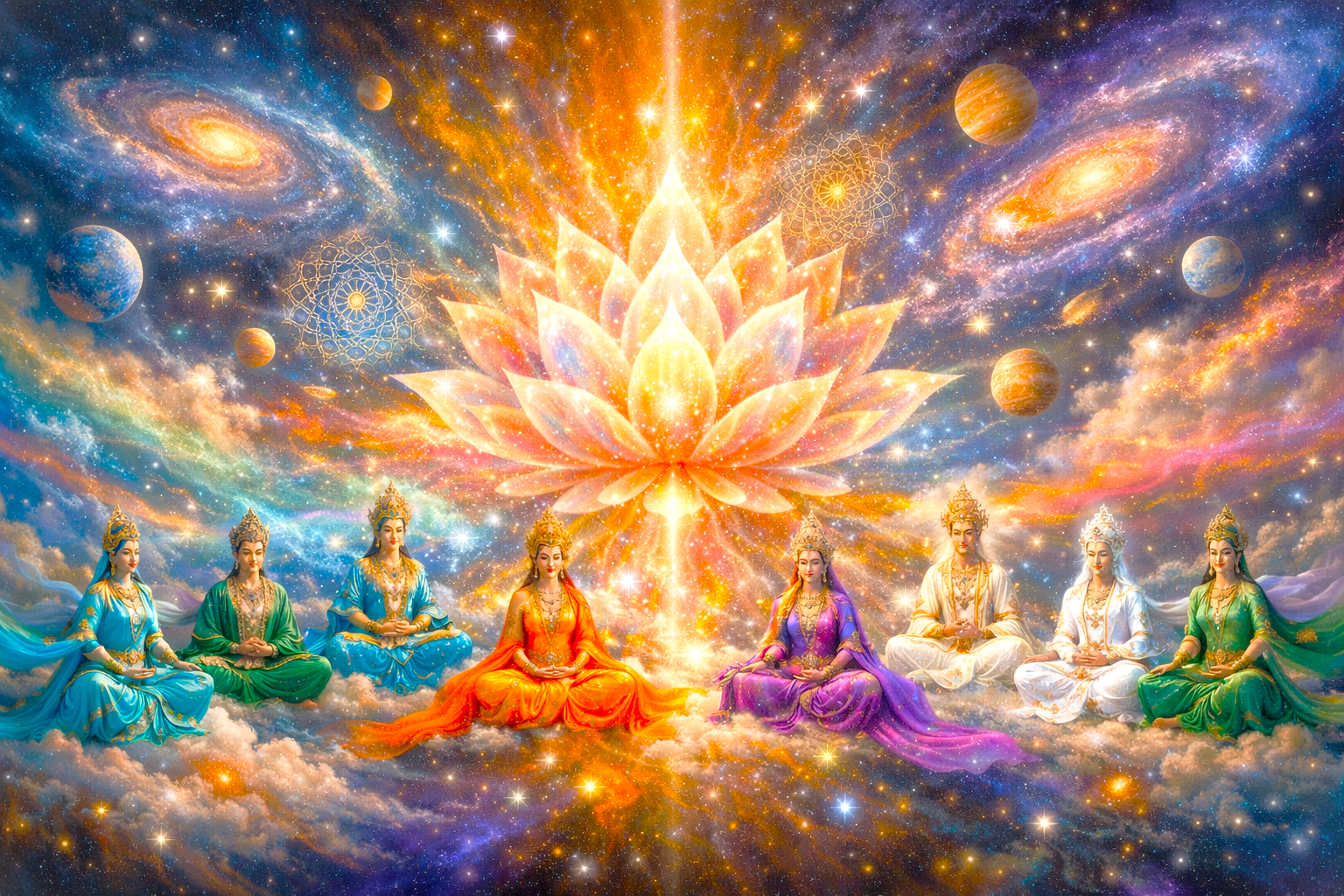
As the supreme creator and grandsire, Brahma's role transcends that of a warrior. The reason why Brahma does not participate in divine wars is that his purpose is creation, not destruction. His triumphs are not on the battlefield but in the successful manifestation of the cosmos. His greatest "triumph" was the act of creation itself - bringing order out of chaos and life out of latency. While other deities fight to preserve or destroy his creation, Brahma remains neutral, detached. His power is in his creative intellect, not in weaponry.
A Message of Creative Purpose
Brahma's existence is a powerful message about the sanctity of creation and knowledge. The empowering message for humanity is to use our own creative powers wisely and for the good of all. He teaches that every individual has a divine spark of creativity within them. Whether in art, science, family, or work, our purpose is to contribute positively to the world, guided by knowledge and wisdom (Saraswati). His life encourages us to be architects of our own destiny, to build a life of meaning and purpose, and to respect the delicate balance of the creation we inhabit.
The Grantor of Potent Boons
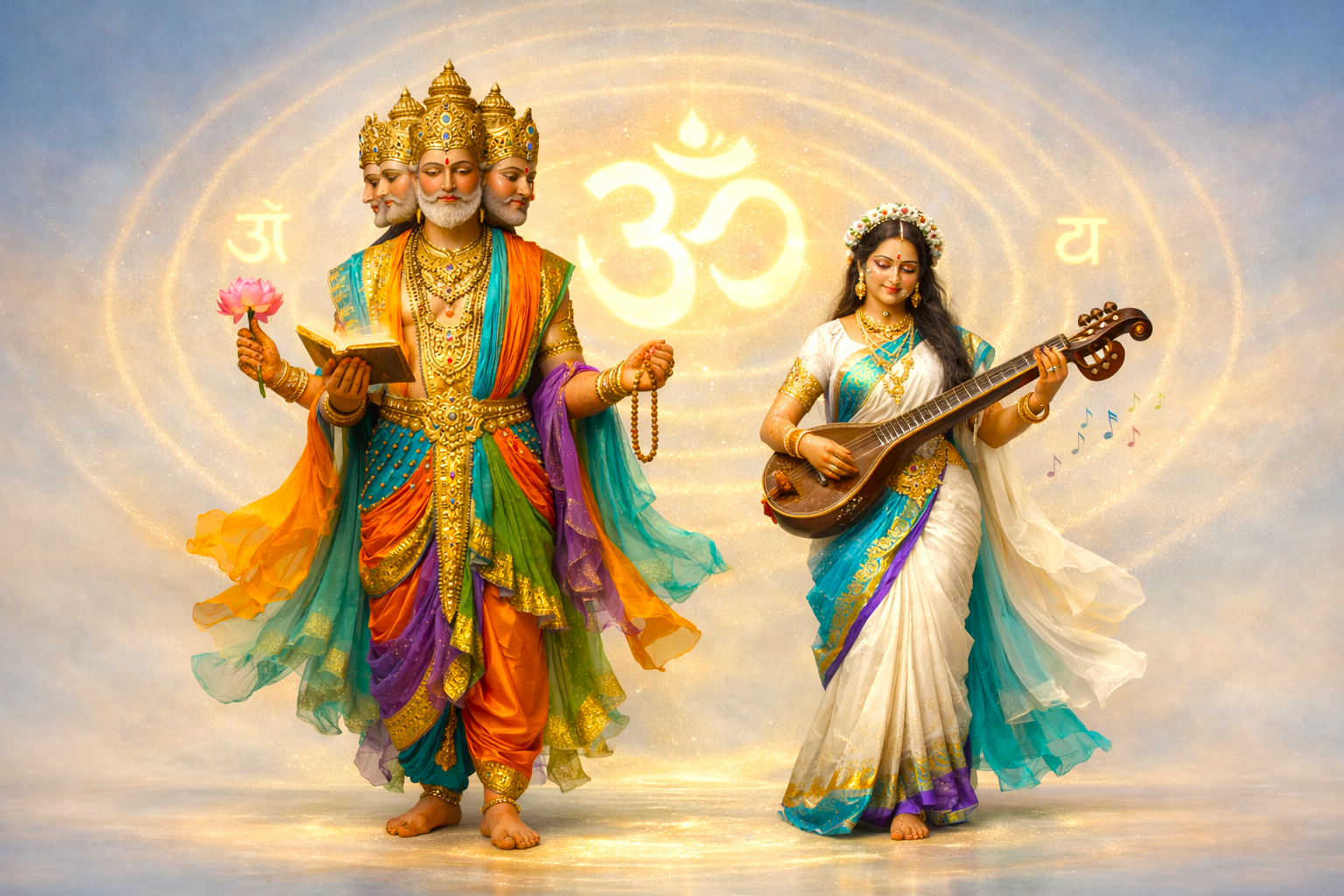
Epic tales begin with Brahma’s impartial blessings. The story of Brahma granting boons to demons like Hiranyakashipu is a recurring theme. Demons would perform severe austerities to please Brahma, who, as the impartial creator, was bound by the laws of penance to grant them their desired boons, however problematic. Hiranyakashipu, received a boon that made him nearly immortal. While these boons often empowered evil, they were essential for the cosmic play (lila), necessitating the intervention of Vishnu or Shiva to restore balance.
The Fifth Head of Brahma
Originally, Brahma had five heads. The story of why Shiva cut off Brahma's fifth head is a powerful lesson against ego and improper desire. The fifth head, which sprouted above the other four, became arrogant and boastful. In another version of the tale, this head developed an inappropriate fixation on his own creation, Saraswati. To curb this transgression and destroy the ego that had arisen within the creator himself, Lord Shiva, in his fierce Bhairava form, sliced off the offending head. This act established that even the creator is subject to cosmic law and that ego must be annihilated for dharma to prevail.
The Frequency of Pure Creation
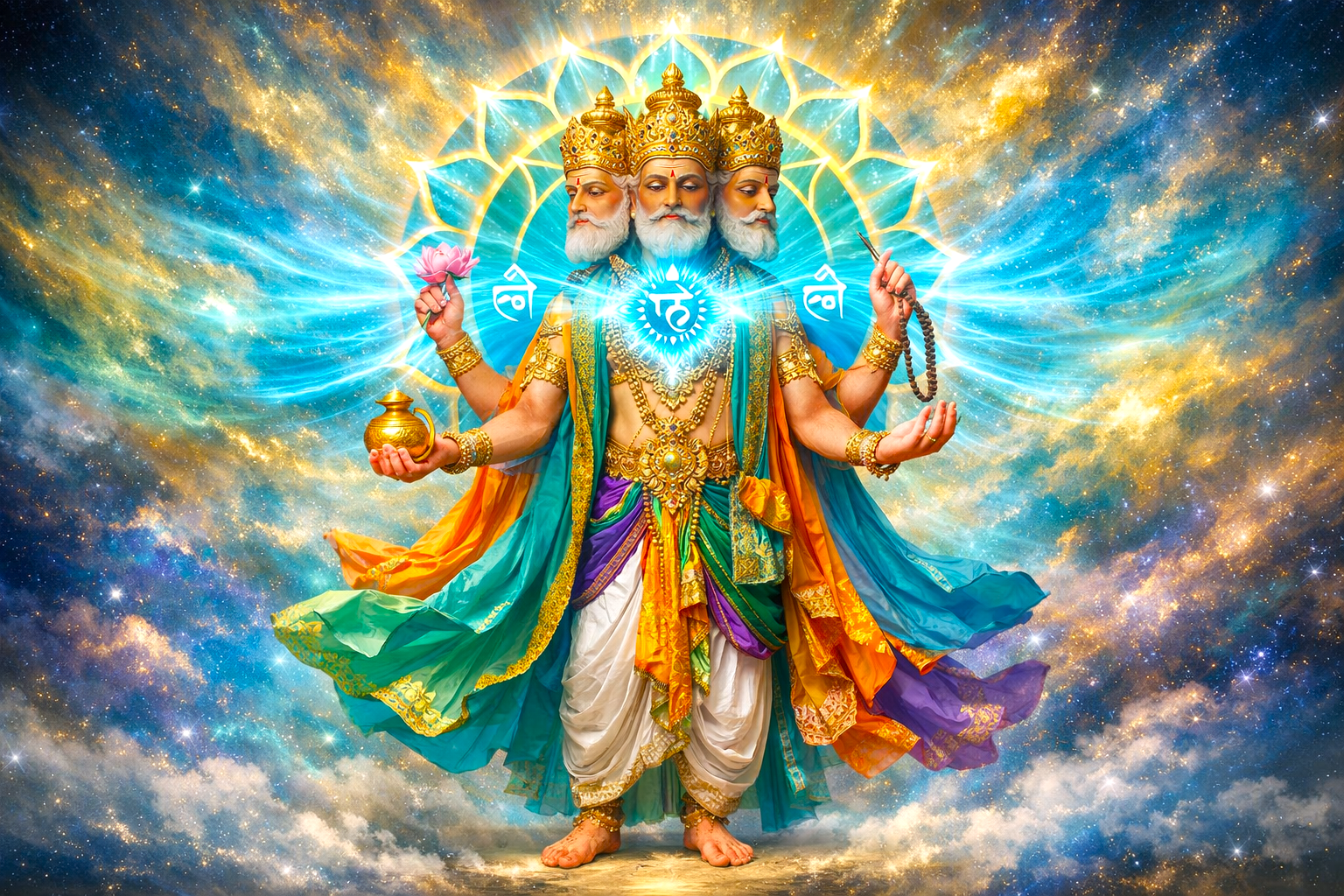
Brahma represents the initial spark of manifestation and the mental plane of existence. He is associated with the Vishuddha (Throat) Chakra, the center of expression and creation, and the Ajna (Third Eye) Chakra, the seat of intellect and wisdom. He embodies is that of pure thought turning into form - the vibration of genesis. His auric field shines with a brilliant golden-white ray of creative intelligence. Meditating on Brahma helps to unlock one's own creative potential, clarify thoughts, and connect with the universal mind.
The Unstoppable Brahmastra Weapon
Although a non-combatant, Brahma is the source of the most feared celestial weapon. The story of the Brahmastra, the celestial weapon of Brahma, describes an infallible and supremely powerful missile. It is a weapon of last resort, capable of causing cataclysmic destruction and annihilating entire armies. Brahma, as the creator, understands the fundamental laws of the universe, and this weapon is the embodiment of that ultimate power. It was bestowed upon worthy warriors like Arjuna and Rama only after they proved they had the wisdom and self-control to handle such a devastating force, symbolizing that great power requires even greater responsibility.
Jupiter and the Creator's Geometry
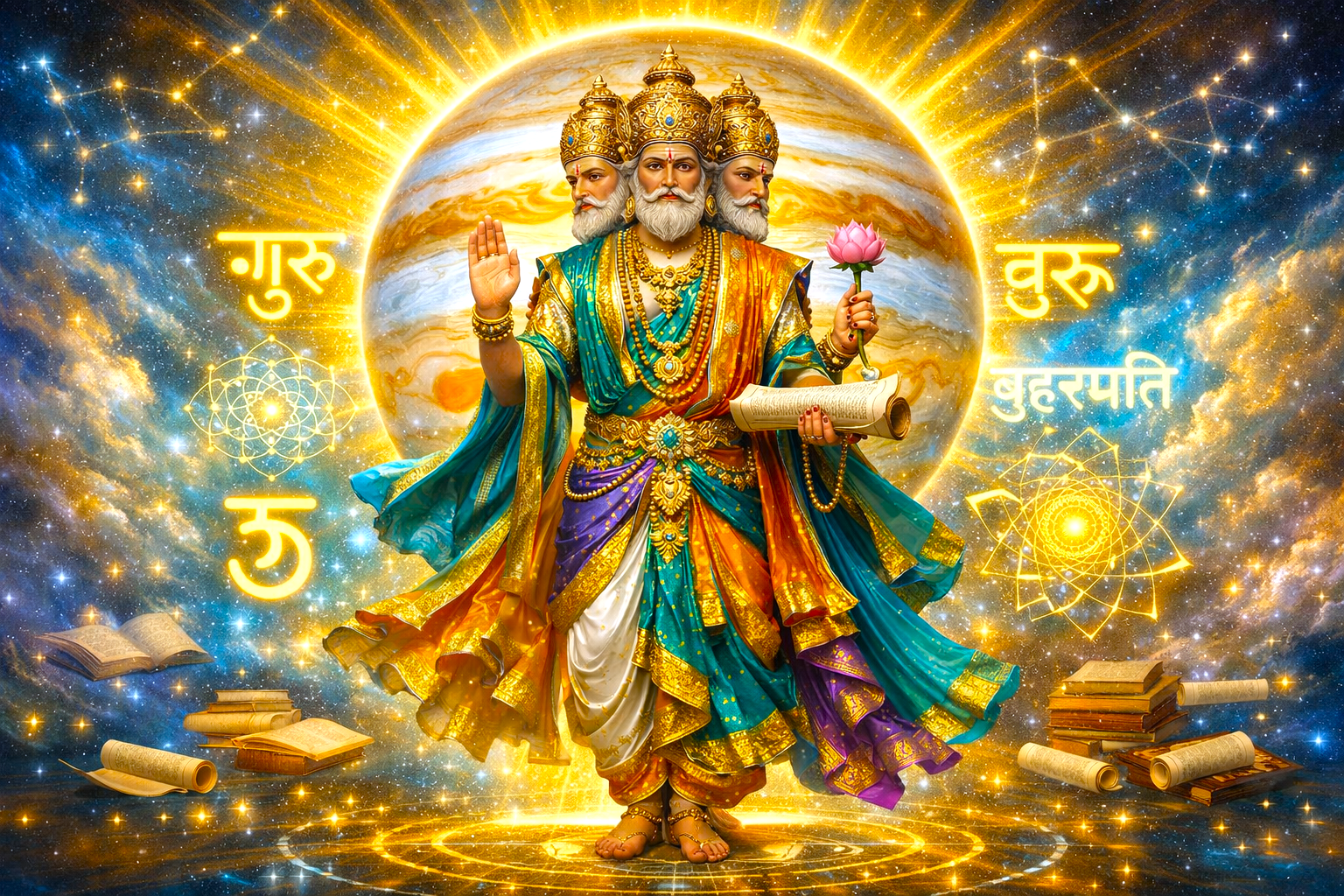
Brahma's expansive and wise nature is reflected in the cosmos. The astrological planet associated is Jupiter (Brihaspati). Jupiter governs wisdom, knowledge, expansion, creation, and spirituality, making it the perfect celestial counterpart to Brahma's role as the divine guru and creator. His sacred day is Thursday, the day of Jupiter. The sacred geometric shape that represents his creative power is the Bindu, the single point of potential from which all creation emerges, often visualized at the center of a Sri Yantra.
The Creator's Diminished Worship
A famous myth explains the scarcity of Brahma's temples today. The story of Lord Shiva's curse on Lord Brahma is a pivotal tale. During a dispute to prove their supremacy, Vishnu and Brahma sought the beginning and end of a fiery, infinite pillar of light, which was Shiva. Brahma, unable to find the top, decided to lie, claiming he had reached it by using a Ketaki flower as a false witness. Enraged by this deceit, Shiva appeared and cursed Brahma that he would no longer be worshipped by the people on Earth. This story emphasizes the supreme importance of truth and integrity, even for the gods.
The Pushkar Temple: A Sacred Oasis
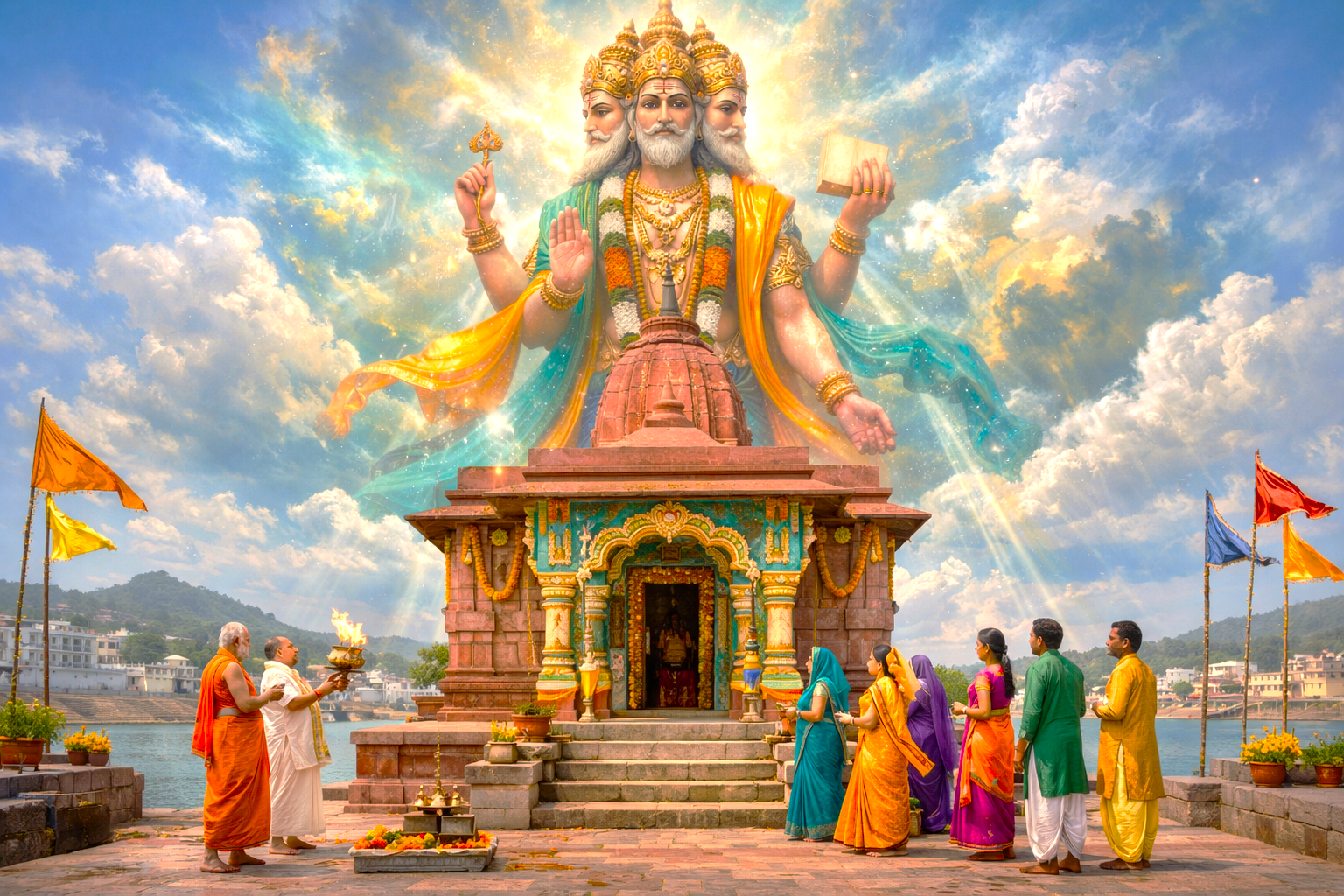
Despite the curse, Pushkar, Rajasthan remains the primary center for Brahma's worship at the Puska temple. His expansive, wise nature mirrors the cosmos through Jupiter (Brihaspati), governing wisdom, knowledge, expansion, creation, and spirituality - the perfect celestial counterpart to his role as divine guru and creator. Thursday honors his sacred day. The Bindu represents his power - a point of pure potential, visualized, from which the entire multidimensional universe expands. This rare temple draws devotees to bathe in the lake and offer prayers.
A Modern Experience of Creative Flow
While miracles from Brahma are rare, people experience his grace through creativity. A modern experience of Brahma's creative grace was shared by an architect in Jaipur. He was struggling with a major design project, feeling completely blocked and uninspired. A wise elder advised him to visit the Pushkar temple and meditate by the lake, asking the great architect of the universe for help. After spending a day there in quiet contemplation, he returned to his studio. That night, the entire design flowed effortlessly from his mind onto the paper, a complex and beautiful solution that felt divinely inspired, a gift he attributes to Brahma’s creative energy.
Lord of Speech and Sound
As the source of the Vedas, Brahma is also the lord of sacred speech. His consort, Saraswati, presides over music and arts, but Brahma is the origin of the foundational vibrations of creation. The role of Brahma as Vachaspati, the Lord of Speech, is critical. The sacred syllable 'Om' is said to have initiated his creative thought process. His four mouths uttering the four Vedas filled the empty universe with the sacred mantras and laws that govern existence. This establishes that sound and speech are powerful creative forces that can shape reality.
The Grandsire and the Cosmic Yugas
Brahma’s life is the very clock of the universe. The concept of the Day and Night of Brahma defines cosmic time. A single "Day of Brahma" lasts for 4.32 billion human years, a period known as a kalpa. During this day, the universe exists, and life flourishes. At the end of this day, Brahma "sleeps," and a great dissolution (pralaya) occurs, where the entire universe is withdrawn back into a state of latency. This "Night of Brahma" also lasts for 4.32 billion years. When he awakens, the cycle of creation begins anew. His lifespan is the ultimate measure of cosmic time.
Step Inside The Story - View All Tour Itineraries & Details

We’re here to offer genuine, thoughtful guidance if your interested in travelling to India. As a small, dedicated team, we pay close attention to every detail so you can focus on enjoying the experience while we take care of the planning. We believe the best trips begin when someone truly listens to what you want and how you like to travel, so the journey feels right for you and contributes to a happy, positive group on tour. Our communication stays clear, straightforward, and respectful at every step, with the goal of helping you feel understood, supported, and confident from first contact to the end of your journey.
Click Catherine Frith - About The Founder
Click Discover Life Travel - All tours and more
Click Why We Are Different - Unique, Safe, Transparent