Unique Insights Into The Deities Of India
Monkey Army of Kishkinda
Discover Life Travel
Children of the Gods in Animal Form
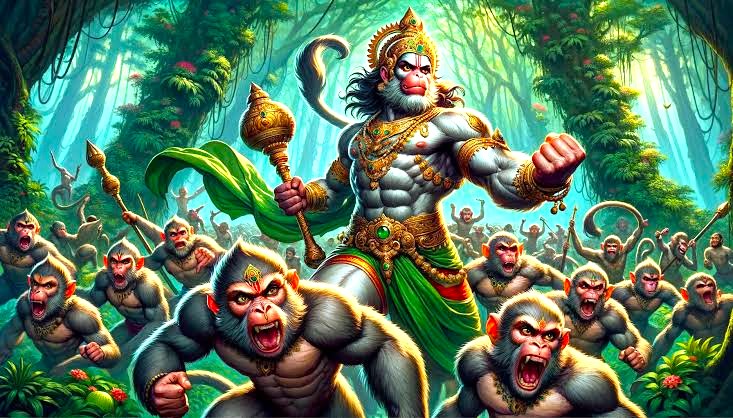
To aid Vishnu in his coming incarnation as Rama, the creator god Brahma commanded the other gods to sire children in the wombs of female Vanaras (divine forest-dwellers). The divine origin of the Vanara army is this mass celestial incarnation. Indra fathered the mighty Vali: Surya, the Sun God, fathered Sugriva: Vayu, the Wind God, fathered Hanuman: and the Ashvins fathered Nala and Nila. This was not a normal army; it was a race of demigods, born with immense strength, the ability to shapeshift, and an innate connection to the divine, waiting in their forest kingdom for the call to fulfill their epic destiny. Monkey Army of Kishkinda
Monkey Army of Kishkinda
The Vanara race made their home in a kingdom that was a natural fortress of breathtaking beauty. The sacred geography of the Kishkindha kingdom, identified with the stunning boulder-strewn landscapes around Hampi in modern-day Karnataka, was their stronghold. With its capital protected by deep caves and towering hills, Kishkindha was a realm of immense natural power. It was from this kingdom that the army was mustered, from the Rishyamuka mountain where the exiled Sugriva lived, to the shores of the great ocean, the landscape itself playing a crucial role in their strategy and mobilization.
Primal Force and Unwavering Devotion
The symbols of the Vanara army are the very forces of nature they embody. Their primary symbol is their primal, untamed physical strength, the ability to wield mountains and trees as weapons. Their collective war-cry, "Jai Shri Ram!" (Victory to Lord Rama!), became their ultimate symbol, representing their unwavering devotion and the divine purpose of their campaign. They are a symbol of nature itself rising to defend Dharma, a chaotic however a powerful force united by a singular, righteous cause. Monkey Army of Kishkinda
A Hierarchy of Divine Generals
The Vanara army was a massive force led by a council of legendary heroes. The king and commander-in-chief was Sugriva, the son of the Sun God. The de facto general and greatest hero was Hanuman, the son of the Wind God. The crown prince and a mighty warrior was Angada, the son of the invincible Vali. The chief engineer was Nala, the divine son of the architect Vishvakarma. His deputy was Nila, the son of Agni, the Fire God. And the ancient, wise counselor guiding them all was the bear-king Jambavan. This leadership was a divine cabinet of war, each member possessing unique, god-given skills.
An Army United by an Exiled King
Before the arrival of Rama, the Vanara army was a fractured force. The story of the army under the exiled Sugriva was one of helplessness. After being unjustly exiled by his brother Vali, Sugriva lived in fear with a small band of loyal ministers, including Hanuman and Jambavan. The bulk of the Kishkindha army remained under Vali's control. It was only after Rama killed Vali and crowned Sugriva as the new king that the fractured parts of the army were reunited, their full, immense power finally consolidated under a single, grateful, and righteous leader.
The Great Search in Four Directions
The army's first great mission was not a battle, but a search. The story of the Vanara army's search for Sita was a logistical marvel. To fulfill his vow to Rama, the newly crowned King Sugriva mobilized his entire race. He divided his massive army into four divisions, sending each to one of the four cardinal directions - north, south, east, and west. He gave them a one-month deadline to find the abducted queen, setting in motion the largest search party in mythological history and demonstrating his absolute commitment to Rama's cause. Monkey Army of Kishkinda
Leaping Mountains and Brawling with Nature
The Vanaras did not ride horses or chariots; their "vehicles" were their own super-human bodies. The divine abilities of the Vanara warriors allowed them to leap over mountains, cross rivers in a single bound, and communicate over vast distances with their powerful roars. They were masters of a unique form of warfare, perfectly adapted to their rugged forest environment. Their ability to move with incredible speed and agility across any terrain made them a mobile and unpredictable fighting force, a true guerrilla army guided by divine power.
The Great Leap of a Solitary Hero
While the other search parties failed, the southern party, led by Angada and including Hanuman and Jambavan, reached the ocean. Here, the army's collective effort gave way to a singular, heroic feat. The story of Hanuman’s great leap to Lanka was the turning point of the search. After being reminded of his immense, forgotten powers by Jambavan, Hanuman expanded to a mountain-like form and, with a mighty roar, leaped across the vast ocean to the island kingdom of Lanka. This solo mission, an act of supreme devotion and strength, achieved what the entire army could not.
The Bridge Built of Faith and Floating Stones
After Hanuman located Sita, the next great challenge for the army was how to cross the ocean. The story of the building of the Rama Setu bridge was a miracle of divine engineering. Under the expert guidance of the architect Nala, whose divine boon made any object he touched float on water, the entire Vanara army set to work. Millions of warriors brought massive boulders, trees, and entire hillocks, which Nala and his brother Nila placed in the water. In five days, this devoted army of laborers built a 100-yojana-long bridge across the ocean, a testament to their collective power when united in a divine purpose. Monkey Army of Kishkinda
A Victorious Return to Forest Life
After the great war was won, Ravana was defeated, and Sita was rescued, the Vanara army's divine purpose was fulfilled. The story of the Vanara army's demobilization is a simple one. Laden with honors and gifts from a grateful Lord Rama, the divine warriors did not seek to rule or conquer further. Their mission was over. They joyfully returned to their homes in the forests and mountains of Kishkindha, disappearing back into the nature from which they came, their epic tale complete. They were a divine army raised for a single purpose, and once that purpose was met, they peacefully disbanded.
A Message: Even Primal Power Must Serve Dharma
The Vanara army offers a powerful lesson about the nature of strength and devotion. The empowering message from the Vanara army is that even the most chaotic, primal, and untamed forces of nature can be channeled into a powerful tool for righteousness when united by a divine purpose. They teach that loyalty and devotion (bhakti) can organize raw power (shakti) into an unstoppable force. Their story is a celebration of teamwork, demonstrating that an army of millions, working together with faith, can achieve the impossible, from building a bridge across an ocean to defeating a cosmic evil.
The Root and Sacral Chakras: A Ray of Earthy Power
As a force of nature, embodying primal strength and survival instincts, the Vanara army's energy is centered in the lower chakras. They are a collective embodiment of the Muladhara (Root) Chakra, which governs physical strength and survival, and the Svadhisthana (Sacral) Chakra, which governs emotion and creative energy. The key frequency of the Vanara army is that of raw, untamed, and earthy power. Their collective auric field would be a massive, chaotic cloud of deep reds and earthy browns, symbolizing their immense physical power, their connection to the wilderness, and their passionate devotion. Monkey Army of Kishkinda
The Unforged Weapons of the Wilderness
The Vanaras rarely used swords or spears; their armory was the wilderness itself. The Vanaras' use of trees and mountains as weapons was their signature fighting style. With their immense strength, they could uproot the largest trees and use them as colossal clubs. They could tear off mountain peaks and hurl them at their enemies like divine missiles. Their fists and teeth were also formidable weapons. This fighting style showed that their power was not dependent on technology or craftsmanship, but was an innate, primal force drawn directly from the living earth.
The Planets Mars and the Sun: An Army of Fiery Loyalty
The nature of the Vanara army is perfectly reflected in the two great planets of leadership and conflict. They are the ultimate embodiment of the planet Mars, which governs soldiers, energy, courage, and warfare. Their aggression and immense physical power are classic Martian traits. At the same time, their unwavering loyalty and service to their king, Sugriva, and the supreme king, Rama, link them directly to the power of the Sun, which governs royalty, loyalty, and dharma. The Vanara army is an astrological marvel: a Martian force of soldiers completely dedicated to a Solar cause.
A Modern Tale: A Volunteer Army in a Natural Disaster
The spirit of the Vanara army is alive today in times of great crisis. A modern parallel to the Vanara army can be seen in the spontaneous formation of a massive volunteer force after a devastating natural disaster. Thousands of ordinary people (the Vanaras) from all walks of life, with different skills, come together under a common cause. They are led by experienced community organizers (Sugriva and Jambavan) and inspired by a charismatic leader (Rama). They use whatever tools they have - boats, trucks, their bare hands (trees and rocks) - to search for survivors (Sita) and rebuild a shattered community (build the bridge), demonstrating the immense power of a united, selfless community. Monkey Army of Kishkinda
The Unstoppable Force in the Great War for Sita
In the final war in Lanka, the Vanara army was the indispensable ground force. The role of the Vanara army in the Lankan war was to form the bulk of Rama's fighting machine. They fought with unparalleled ferocity, overwhelming Ravana's highly trained Rakshasa soldiers through sheer numbers and raw, unpredictable power. While Rama, Lakshmana, and the generals fought the main Rakshasa commanders, it was the millions of Vanara soldiers who cleared the path, destroyed fortifications, and engaged the demonic infantry, making the final victory possible.
Step Inside The Story - View All Tour Itineraries & Details

We’re here to offer genuine, thoughtful guidance if your interested in travelling to India. As a small, dedicated team, we pay close attention to every detail so you can focus on enjoying the experience while we take care of the planning. We believe the best trips begin when someone truly listens to what you want and how you like to travel, so the journey feels right for you and contributes to a happy, positive group on tour. Our communication stays clear, straightforward, and respectful at every step, with the goal of helping you feel understood, supported, and confident from first contact to the end of your journey.
Click Catherine Frith - About The Founder
Click Discover Life Travel - All Tours and More
Click Why We Are Different - Unique, Safe, Transparent