Unique Insights Into The Deities Of India
Meenakshi: Warrior Goddess
Discover Life Travel
The Princess Born from a Sacrificial Fire
The Pandyan king, Malayadhwaja, and his queen, Kanchanamalai, were childless and performed a great Putrakameshti Yajna (fire sacrifice) to pray for a son. From the heart of the sacred flame, a being of incredible radiance emerged. The divine origin story of Goddess Meenakshi is that she was born not as a baby, but as a fully formed three-year-old girl. She was exquisitely beautiful, but for one anomaly: she had a third breast. A divine voice proclaimed that the third breast would vanish the moment she laid eyes on her destined husband. This miraculous birth occurred in the ancient city of Madurai in Tamil Nadu, marking her as a divine gift to a righteous king. Meenakshi Warrior Goddess
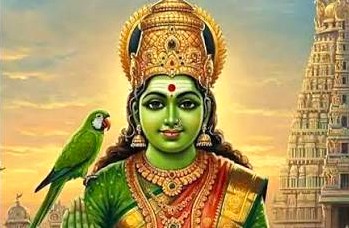
Meenakshi Warrior Goddess: The Fish-Shaped Eyes of Divine Vigilance
Meenakshi's very name is her most potent symbol. Meaning "the one with fish-shaped eyes" (mina-akshi), the symbolism of Meenakshi's beautiful fish-shaped eyes is profound. Fish never close their eyes, symbolizing that the goddess is eternally watchful, her compassionate gaze always protecting her devotees and her city without a moment's rest. Her other primary symbol is the divine scepter she holds as a warrior queen, representing her sovereign rule and her power to dispense justice. A green parrot, often perched on her right hand, represents her connection to love, nature, and the transmission of sacred knowledge.
The Royal Family of Madurai's Divine Queen
Meenakshi's family story is the sacred heart of Madurai's spiritual identity. Her earthly father was the Pandyan King Malayadhwaja, and her mother was Queen Kanchanamalai. After a life as a warrior princess, she fulfilled her destiny by marrying the supreme ascetic god, Shiva, in his handsome local form as Sundareswarar, the beautiful lord. This divine marriage made her the daughter-in-law of the cosmos itself. Though a form of the universal mother Parvati, in her Madurai lila, her parents are the royal family, grounding her divine story in the history and lineage of the Tamil land. Meenakshi Warrior Goddess
The Warrior Queen's Unconventional Youth
Born from a fire sacrifice, Meenakshi was raised as the heir to the throne. The story of her training as a warrior princess shows her mastering all 64 traditional arts, including warfare, politics, and strategy. She was a formidable warrior, skilled with the sword, the spear, and the bow. After her father's death, she was crowned the queen of the Pandyan kingdom, ruling with wisdom and strength. Her "childhood to marriage" was a period of consolidation of power, where the divine goddess learned and excelled in the worldly duties of a monarch. Meenakshi Warrior Goddess
The Conquest That Led to a Divine Union
As a sovereign queen, Meenakshi embarked on a Digvijaya, a traditional military campaign to establish her dominion over the entire world. The story of Queen Meenakshi's conquest of the world saw her defeat armies in all directions, subduing kings and even the celestial Devas, including Indra. Finally, her victorious campaign brought her to the Himalayas, the abode of Shiva. As she prepared to battle the serene, handsome ascetic who stood in her path, she laid eyes on him, and at that moment, the prophecy was fulfilled. Her third breast vanished, and the fierce warrior queen instantly transformed into a shy, blushing bride, for she had finally met her destined lord. Meenakshi Warrior Goddess
The Parrot of Love, The Scepter of Rule
As a sovereign queen, Meenakshi’s vehicle is her royal authority and the lion throne from which she rules. Her symbolism of the green parrot as her companion is particularly beloved. The parrot, often associated with Kama, the god of love, represents the blossoming of love in the fierce warrior's heart. It also symbolizes the teaching of the sacred Vedas, as a parrot perfectly repeats what it hears. Her primary 'instrument' is not a musical one, but the royal scepter (sengol), the instrument of righteous governance with which she conducts the affairs of the kingdom and protects her subjects.
The Victorious Queen of the Entire Cosmos
Meenakshi's great triumph was her Digvijaya, a war that established her as the supreme power. The story of Meenakshi's triumph over all the gods is a powerful statement of the supremacy of Shakti, the divine feminine energy. She did not wage war for greed or territory, but to establish her inherent sovereignty as the ruler of the universe. By defeating all the male deities, including the king of the gods, Indra, she proved that the ultimate power in the cosmos is the divine mother. Her final "conquest" was not a battle, but a surrender to love, showing that her ultimate triumph was the union with her divine consort. Meenakshi Warrior Goddess
The Grandest Wedding in Cosmic History
The culmination of herconquest was her marriage. The celestial wedding of Meenakshi and Sundareswarar is the most important festival in Madurai. Vishnu, as her divine brother, traveled from his abode to preside over the wedding and give the bride away. All the gods, goddesses, sages, and celestial beings descended upon Madurai to witness this grand event. Her "death" was the shedding of her separate identity as a mortal queen, as she merged with her husband to rule eternally from their temple, becoming the deified joint rulers of the Madurai Meenakshi Amman Temple, the spiritual heart of the city. Meenakshi Warrior Goddess
Her Message: Balancing Power with Grace
Meenakshi's life is a powerful message about the integration of seemingly opposite qualities. The empowering message from Meenakshi is that a woman can be both a fierce, powerful ruler and a loving, graceful consort. She embodies the perfect balance of worldly power and spiritual devotion, of righteous anger and compassionate love. She teaches that true sovereignty comes from inner strength and that the ultimate purpose of power is to lead one towards a divine union. She is an inspiration for balancing worldly duties with a deep spiritual core. Meenakshi Warrior Goddess
The Heart Chakra and the Emerald Green Ray
As the divine queen who found her ultimate purpose in love, Meenakshi's energy is centered in the heart. She is the supreme ruler of the Anahata (Heart) Chakra, the center of love, compassion, and divine union. The key frequency that Meenakshi embodies is that of sovereign love and empowered grace. Her aura radiates a brilliant and powerful emerald green ray, symbolizing her connection to the planet Mercury (for her intelligence as a ruler), her compassionate healing energy, and the vibrant love that defines her very essence. Meditating on her helps to open the heart and balance worldly responsibilities with inner love.
The Sword of Justice, The Scepter of Dharma
As a warrior queen, Meenakshi was a master of all weapons, but her primary celestial weapon is the sword of righteousness. The symbolism of Meenakshi's divine sword is that of Dharma in action. It is the weapon that cuts through injustice, protects the innocent, and defends the kingdom from adharma. It is not a weapon of aggression, its a weapon of protection. After her marriage, this martial power is sublimated into her royal scepter, which becomes her tool for ruling. It signifies that the power to punish and the power to rule both stem from the same divine authority.
The Royal Planets and the Geometry of the Heart
Meenakshi's regal and loving nature is reflected in powerful planetary energies. She embodies the qualities of the Sun, for her role as a powerful, sovereign queen, and Venus, for her immense beauty and her identity as a goddess of love. As the ruler of Madurai, the city's layout itself becomes her sacred geometry. The entire city of Madurai is designed as a Sri Yantra, with the temple at its center, making the city a massive, living geometric diagram of her divine energy. Worshiping her is believed to bestow both royal grace and the blessings of true love.
A Modern Miracle of the Fish-Eyed Goddess
Devotees constantly experience Meenakshi's grace as the protector of her city. A modern miracle story from a devotee in Madurai tells of a small shopkeeper whose shop was on the verge of bankruptcy. One night, he had a vivid dream of the goddess, her fish-shaped eyes full of compassion, handing him a single green parrot feather. The next morning, a complete stranger, a tourist, walked into his shop and, charmed by a small, insignificant item, made a massive bulk purchase that single-handedly saved his business. The shopkeeper believes the stranger was the goddess herself in disguise, sent in response to his prayers.
The Goddess Who Rules as Queen
Unlike many temple deities who are consorts, in Madurai, Meenakshi is the primary ruler. The tradition of Meenakshi being the ruling deity of Madurai is unique. The daily rituals, the temple's orientation, and the major festivals all revolve around her. Sundareswarar, though Shiva himself, is her consort and co-ruler. The coronation ceremony is performed for her, and it is her scepter that holds the authority. This matriarchal tradition makes her a powerful symbol of female sovereignty and spiritual authority, where the goddess is not a subordinate, but the chief executive of the divine kingdom.
The Divine Game of the Goddess
The mythology of Meenakshi and Sundareswarar is filled with stories of their divine play. The Thiruvilaiyadal Puranam, the stories of their 64 divine games, are beloved in Tamil culture. These are tales of the divine couple taking on various disguises - a fisherman, a woodcutter, a poet - to interact with their devotees, test their faith, and bestow their grace. These stories reveal a playful, accessible side to the divine rulers, showing them not as distant gods, but as active participants in the daily lives of the people of their city.
The Brother Who Arrived Late for the Wedding
A famous part of the celestial wedding festival involves Meenakshi's brother. The story of Vishnu's journey for the Meenakshi wedding is a popular tale. As her brother, Vishnu was supposed to preside over the ceremony and give her away. He was delayed on his journey. An impatient Indra, wanting the wedding to proceed at the auspicious time, took the form of Vishnu and performed the rites. When the real Vishnu finally arrived at the Vaigai river on the outskirts of Madurai and heard the wedding was already over, he was angered and, refusing to enter the city, returned to his abode. This event is re-enacted every year. Meenakshi Warrior Goddess
The Green Goddess of Madurai
Meenakshi is almost always depicted with a radiant, emerald-green complexion. The symbolism of her green skin is deeply significant. Green is the color of fertility, abundance, and vibrant life. It represents her power to make the lands prosperous and to grant the boon of children to her devotees. It also connects her to the planet Mercury (Budha), which governs intellect and commerce, highlighting her role as a wise and astute ruler of a thriving kingdom. Her green form is a visual promise of life, love, and prosperity.
The Queen Who Listens to Her People
In the daily rituals of the great Madurai temple, a unique ceremony takes place. Every night, the priests carry the movable idol of Sundareswarar in a palanquin to Meenakshi's chambers, where he 'spends the night'. Before this, however, the temple accounts for the day are read aloud to her, as the ruling queen. This daily ritual of reading accounts to Queen Meenakshi reinforces her status as the supreme monarch and administrator. It shows that she is not a figurehead, but an active, engaged ruler who is kept informed of all the happenings in her divine kingdom. Meenakshi Warrior Goddess
Step Inside The Story - View All Tour Itineraries & Details
We’re here to offer genuine, thoughtful guidance if your interested in travelling to India. As a small, dedicated team, we pay close attention to every detail so you can focus on enjoying the experience while we take care of the planning. We believe the best trips begin when someone truly listens to what you want and how you like to travel, so the journey feels right for you and contributes to a happy, positive group on tour. Our communication stays clear, straightforward, and respectful at every step, with the goal of helping you feel understood, supported, and confident from first contact to the end of your journey.
Click Catherine Frith - About The Founder
Click Discover Life Travel - All Tours and More
Click Why We Are Different - Unique, Safe, Transparent