Unique Insights Into The Deities Of India
Kunthi: Queen of Sacrifices
Discover Life Travel
The Princess Given Away at Birth
Born as Pritha to King Shurasena of the Yadava clan, she was the sister of Vasudeva, making her the paternal aunt of Krishna. The origin story of Kunti began with an act of sacrifice. Her father had promised his childless cousin, King Kuntibhoja, that he would give him his firstborn. True to his word, Shurasena gave the young princess Pritha to be adopted. It was in the court of her adoptive father that she was renamed Kunti, a name that would become synonymous with suffering, sacrifice, and the immense strength of a matriarch who endured all for the sake of her sons and Dharma. Kunthi Queen of Sacrifices

Kunthi Queen of Sacrifices: Palaces of Power and Forests of Exile
Kunti’s life was a constant, painful journey between the highest seats of power and the deepest wilderness of exile. The sacred geography of Kunti’s life stretched from the royal court of the Kuntibhoja Kingdom where she grew up, to the grand palace of Hastinapura, where she reigned as queen and later suffered as a widow. Her life was defined by long, arduous years in the wilderness: first with her husband Pandu in a forest hermitage, and later during the thirteen-year exile with her sons, the Pandavas. Her final years were also spent in a forest, making the wilderness both a place of her greatest sorrow and the crucible where her sons' characters were forged.
The Sacred Mantra of Divine Conception

The most powerful symbol associated with Kunti was a divine gift she received in her youth. The symbolism of the divine mantra given to Kunti by the sage Durvasa is the key to her entire story. This mantra was a sacred formula that allowed her to invoke any god and have a child with them, a boon of immense power. Her other symbol is her unwavering, fierce maternal love, a bond that held the five Pandava brothers together as a single unit despite their different fathers and mothers. She is the ultimate symbol of motherhood as a form of divine duty and immense sacrifice. Kunthi Queen of Sacrifices
A Family of Secret Sons and Celestial Fathers
Kunti’s family tree is a complex web of divine secrets and human tragedy. As Pritha, she was the paternal aunt of Krishna, a relationship that afforded her a unique connection to the divine. Her adoptive father was King Kuntibhoja. She was the first wife of King Pandu of Hastinapura, and her co-wife was Madri. Her greatest secret was her firstborn son, Karna, born from the Sun God Surya. Her three legitimate sons were Yudhishthira (from the god Dharma), Bhima (from the wind god Vayu), and Arjuna (from Indra, king of the gods). She was also the loving stepmother to Madri’s twin sons, Nakula and Sahadeva.
The Service to a Sage and a Secret Tested Too Soon

As a young maiden in King Kuntibhoja’s palace, Kunti was tasked with serving the notoriously short-tempered sage Durvasa for a full year. The story of Kunti serving the sage Durvasa is a testament to her patience and devotion. She served him with such perfect dedication that the pleased sage, foreseeing her future fate of a childless marriage, granted her a powerful boon. He taught her the Atharvan mantra that would allow her to summon a god and bear his child. After he left, the young, curious Kunti, wishing to test the power of the boon, made a fateful decision that would haunt her for the rest of her life.
The Firstborn Son Abandoned on the River's Current
Driven by youthful curiosity, Kunti decided to test the mantra. She gazed at the rising sun and invoked the Sun God, Surya. The story of Kunti giving birth to her secret son, Karna, was the immediate and terrifying result. Surya appeared and, despite her pleas, was bound by the mantra's power to grant her a son. To hide her shame and preserve her honor as an unmarried princess, Kunti made a heart-wrenching choice. She placed the divinely-born child, adorned with his celestial armor and earrings, in a basket and cast him adrift on the river, a secret she would carry with agonizing guilt for most of her life. Kunthi Queen of Sacrifices
A Cursed King and a Boon for a Barren Lineage

Kunti won the hand of the mighty King Pandu of Hastinapura at her swayamvara. However, their happiness was short-lived. While hunting, Pandu accidentally shot a sage who was in the middle of mating in the form of a deer. The dying sage cursed Pandu, declaring that the moment he tried to be intimate with either of his wives, he would die instantly. The story of King Pandu’s curse of childlessness plunged him into despair. Heartbroken, Pandu renounced the throne and retired to the forest with Kunti and his second wife, Madri.
The Divine Sons Summoned from the Heavens
In the forest, with Pandu's blessing, Kunti finally revealed her long-held secret of Durvasa's boon. To fulfill their duty to produce heirs, she systematically used the mantra. The story of Kunti giving birth to the Pandava brothers was a deliberate act of divine conception. She first invoked Dharma, the god of justice, to father the righteous Yudhishthira. Next, she summoned Vayu, the god of wind, to father the mighty Bhima. Finally, she called upon Indra, the king of the gods, to father the great archer Arjuna. Through this incredible power, she bore three sons, each embodying the divine qualities of their celestial sires. Kunthi Queen of Sacrifices
The Shared Secret and the Sons of a Co-Wife

After the birth of her three sons, Kunti's co-wife, Madri, also wished to have children. Pressured by Pandu, Kunti generously shared the sacred mantra with her. The story of Kunti sharing the mantra with Madri shows her magnanimous nature. Madri, in a clever move, invoked the Ashvins, the divine twin horsemen, and gave birth to her own beautiful twin sons, Nakula and Sahadeva. After Madri's death, Kunti did not treat these boys as step-children, but raised them with the same love and affection as her own three sons, forever binding the five Pandavas into a single, indivisible unit.
The Final Retreat into a Forest of Penance
Many years after the Kurukshetra War had ended and Yudhishthira was firmly established as king, Kunti made a final, shocking decision. The story of Kunti’s departure to the forest showed her ultimate detachment. Feeling her life's purpose was complete, she chose to renounce the comforts of the palace she had fought so hard to regain for her sons. She joined Dhritarashtra and Gandhari in their retirement to the forest. This act of renunciation was her final sacrifice, a choice to pursue spiritual liberation over royal comfort. Like them, she perished in a forest fire, meeting her end not as a queen, but as a humble ascetic.
The Heart and Earth Chakras: An Earthy Gold and Blue Ray
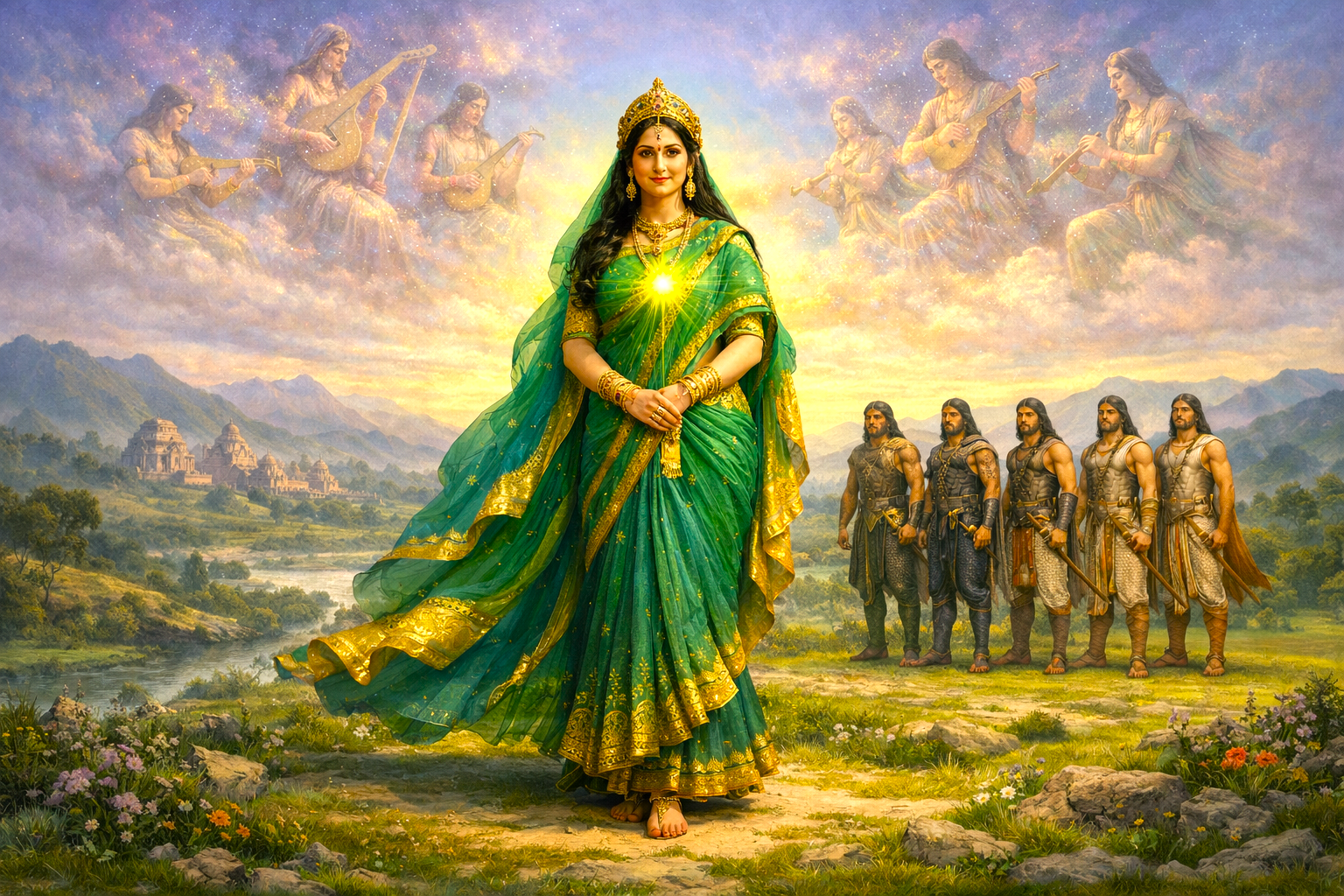
As the great mother of the Pandavas, a queen who endured immense emotional turmoil, Kunti's energy is centered in the chakras of love and stability. She is a powerful embodiment of the Anahata (Heart) Chakra, which governs her fierce maternal love, and the Muladhara (Root) Chakra, representing her struggle for her sons' survival and rightful place on earth. Her auric field would be a complex mix of earthy gold, representing her royal status and endurance, interwoven with a deep, sorrowful blue ray, representing her secret grief and a lifetime of emotional pain. Kunthi Queen of Sacrifices
A Message: Endure All for the Sake of Dharma
Kunti's life is one of the most powerful stories of female endurance and sacrifice in all of literature. The empowering message from her life is about the immense strength required to uphold Dharma in the face of unimaginable suffering. Her story is a testament to a mother's selfless love and her ability to endure public humiliation, exile, and the agonizing guilt of a secret past, all for the sake of her children's rightful claim. She teaches that duty and righteousness often demand immense personal sacrifice, and that true strength lies not in avoiding suffering, but in enduring it with grace and unwavering resolve.
The Mantra: A Weapon of Divine Creation

Kunti’s "weapon" was of miraculous creation. The divine mantra as Kunti’s secret power was a tool that allowed her to summon the highest forces in the universe. While others fought with bows and maces, Kunti's power was verbal and spiritual. She wielded a sacred formula that could literally produce divine heroes. This "weapon" was double-edged: it gave her the glorious Pandavas, but its premature use also gave her the secret son, Karna, whose existence became a source of immense conflict and personal tragedy.
The Astrological Moon and Saturn: A Mother's Grief
Kunti’s character is a perfect astrological representation of the planets of motherhood and sorrow. She is the ultimate embodiment of the Moon, which governs motherhood, emotion, the mind, and secrets. Her entire life was driven by her maternal instincts and the emotional weight of her hidden past. Her lifelong suffering, the delays in her happiness, and her final ascetic renunciation also connect her powerfully to the energy of Saturn, the planet of duty, responsibility, and sorrow. Kunti's life is a poignant drama of a powerful Moon (maternal love) enduring immense Saturnine (sorrowful) trials.
The Final Confession to Her Secret Son

Just before the Kurukshetra War began, Kunti made a final, desperate attempt to save her sons. The story of Kunti revealing the truth to Karna is one of the epic's most heart-wrenching moments. She went to Karna while he was praying and confessed that she was his mother, begging him to switch sides and join his Pandava brothers. The bitter and loyal Karna refused to betray his friend Duryodhana but, moved by the truth, made a solemn promise: he would not kill any of the Pandavas except for his great rival, Arjuna. Kunthi Queen of Sacrifices
Step Inside The Story - View All Tour Itineraries & Details
We’re here to offer genuine, thoughtful guidance if your interested in travelling to India. As a small, dedicated team, we pay close attention to every detail so you can focus on enjoying the experience while we take care of the planning. We believe the best trips begin when someone truly listens to what you want and how you like to travel, so the journey feels right for you and contributes to a happy, positive group on tour. Our communication stays clear, straightforward, and respectful at every step, with the goal of helping you feel understood, supported, and confident from first contact to the end of your journey.
Click Catherine Frith - About The Founder
Click Discover Life Travel - All Tours and More
Click Why We Are Different - Unique, Safe, Transparent