Unique Insights Into The Deities Of India
Mushika: Taming of the Giant
Discover Life Travel
A Celestial Musician Cursed for a Careless Step
Long ago, in the court of the celestial king Indra, there was a handsome and talented Gandharva (a celestial musician) named Krauncha. The mythological origin story of Ganesha's divine mouse Mushika begins with a moment of carelessness. As Krauncha was rushing through the court, he accidentally stepped on the foot of the sage Vamadeva. The enraged sage, feeling disrespected, instantly cursed the musician for his scurrying, rodent-like behavior, declaring, "You shall become a mouse!" Terrified, Krauncha begged for forgiveness. The sage, softening his curse, prophesied that while he would become a mouse, he would one day have the supreme honor of serving the great Lord Ganesha. Mushika Taming of the Giant
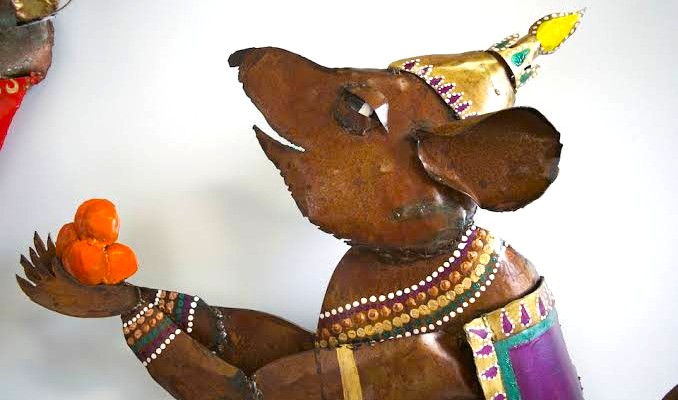
Mushika Taming of the Giant
After being cursed, the Gandharva Krauncha fell from the heavens and transformed into a monstrously large and destructive mouse. The sacred geography of Mushika’s story begins at the peaceful hermitage of the great sage Parashara, near the modern-day city of Nashik in Maharashtra. This giant mouse was not a small creature; it was the size of a small mountain, and it terrorized the ashram, chewing through trees, devouring stores of grain, and destroying the sage's sacred texts. The hermitage became a place of chaos and fear, setting the stage for a divine intervention that would transform this destructive pest into a divine servant.
The Lasso of Dharma, The Speed of Mind
The symbols of Mushika are deeply philosophical, representing the taming of the uncontrolled mind. His most potent symbol is the divine noose or pasha that Lord Ganesha uses to bind him. This lasso represents the power of Dharma and wisdom to rein in the fast, destructive, and desire-driven mind. Mushika himself, in his subjugated form, represents the human mind brought under perfect divine control. His small size symbolizes humility and subtlety, while his incredible speed represents the speed of thought, now channeled to serve a divine purpose instead of causing chaos. Mushika Taming of the Giant
The Divine Servant of the Son of Shiva
Mushika's "family" is the divine household he serves. While born as the Gandharva Krauncha, his true identity is tied to his master. His ultimate "father" and "mother" in a spiritual sense are Lord Shiva and Goddess Parvati, the parents of his master. His divine lord and master, for whom he feels immense devotion, is Lord Ganesha, the remover of obstacles. In this sacred family, Mushika is not a pet, but a devoted servant and a trusted member of the divine entourage. He is the humble vehicle for the son of the Supreme Lord and Lady of the Universe. Mushika Taming of the Giant
From a Destructive Giant to a Humble Mount
The early "life" of Mushika as a giant mouse was one of pure, unrestrained destruction. The story of Mushika as the giant demon-mouse shows him as a creature of immense power and chaotic energy, a metaphor for the untamed ego. He gnawed at the foundations of the ashram, a symbol of how the uncontrolled mind can destroy the foundations of a spiritual life. This period of his life represents the state of a mind ruled by restless desire (rajas), a powerful but directionless force that creates nothing but trouble for itself and others, awaiting the firm hand of a divine master to give it purpose.
The Unwinnable Battle with a Divine Child
Hearing of the chaos caused by the giant mouse, the young Ganesha, son of Shiva and Parvati, decided to intervene. The story of Ganesha taming the giant mouse Mushika is a tale of divine power and wisdom. Ganesha, just a boy, confronted the monstrous rodent. He first threw his divine noose (pasha) and effortlessly looped it around the giant mouse's neck, bringing him to a halt. When the mouse struggled, the heavyweight Ganesha simply leaped onto his back. The immense, divine weight of Ganesha crushed the mouse's pride and arrogance, forcing him to surrender completely.
The Divine Vehicle of the Remover of Obstacles
After being subdued, the giant mouse, his ego crushed, offered his service to Ganesha. Ganesha, pleased with his surrender, accepted him as his eternal vehicle, or vahana. The symbolism of Mushika as Ganesha's divine mount is profound. How can a tiny mouse carry the heavyweight, elephant-headed god? This paradox represents several key ideas: that with divine grace, the smallest and humblest of beings can perform the greatest tasks; and that the all-pervading Ganesha is so light with divine consciousness that the tiny, controlled mind (Mushika) can carry him effortlessly. Mushika Taming of the Giant
The Triumphant Journey to a Devotee's Home
Mushika's greatest triumphs are not battles, but the countless journeys he makes with his master. Every time a devotee sincerely prays to Ganesha, a spiritual journey takes place. The triumph of Mushika is carrying Ganesha to remove obstacles from a devotee's path. His victory is the speed and efficiency with which he carries the Lord to the scene of a problem. Whether it's a student praying before an exam or a business owner starting a new venture, Mushika is the one who, at the speed of thought, brings the obstacle-removing power of Ganesha to where it is needed most, ensuring the devotee's success.
An Eternal Service, A Life Beyond Death
As the divine vehicle of an eternal god, Mushika shares in his master's immortality. There is no death story for the divine vehicle Mushika, as his service is timeless. Having been subjugated and blessed by Ganesha, he is freed from the normal cycle of birth and death. His "death" was the death of his arrogant ego as the Gandharva Krauncha and the demon-mouse. His reward for this surrender was an eternal life of divine service. He exists as long as Ganesha exists, forever ready at his master's feet, a symbol of a soul that has achieved liberation through pure devotion and service.
A Message: Mind A Powerful Servant-Terrible Master
The story of Mushika offers one of the most profound and practical messages in Hindu mythology. The empowering message for humanity from the story of Mushika is a lesson on the nature of the human mind. The mind, like the giant mouse, is fast, restless, and can cause immense destruction when left uncontrolled, gnawing away at our peace and happiness. However, when that same mind is brought under the control of higher wisdom (Ganesha), it becomes the most powerful and useful tool we possess. It teaches that our goal is not to kill the mind, but to tame it and make it our servant on the spiritual path.
The Root Chakra and a Ray of Subdued Earth Energy
Mushika, as a creature of the earth and a symbol of the tamed, foundational mind, is connected to the base of our spiritual anatomy. He represents the energy of the Muladhara (Root) Chakra after it has been purified. The uncontrolled mouse is a blocked Root Chakra (fear, chaos), while the devoted Mushika is a stable one. The key frequency that Mushika embodies is that of focused, grounded, and swift action. His auric field would be a subdued, grayish-brown ray, the color of humble earth, representing a mind that has given up its own fiery pride to serve a higher, divine purpose.
The Teeth That Carved an Epic
While not a weapon of war, Mushika's teeth were once used in a great act of literary service. In one version of the story, when the sage Vyasa needed a scribe to write down the entire Mahabharata, Ganesha offered to do it. During the long dictation, Ganesha's own quill broke. Without a moment's hesitation, Ganesha broke off one of his own tusks to continue writing. In another, more popular version for this part of the story, it's Mushika who offers his service when Ganesha's pen breaks. The divine mouse used his sharp, powerful teeth to carve the epic saga, proving that even a humble tool can be used for a monumental divine purpose. Mushika Taming of the Giant
The Planet Mercury and the Shape of a Point
Mushika's character as a fast, intelligent, and sometimes mischievous entity connects him directly to the planet of the mind. He is a perfect representation of the planet Mercury (Budha), which governs intellect, speed, communication, and adaptability. The untamed mouse is a malefic Mercury (anxiety, deceit), while the devoted Mushika is a benefic Mercury (sharp intellect, good communication). His sacred geometry is the Bindu, the single point or dot, representing the focused, one-pointed concentration of a mind that has been completely tamed and directed towards a single, divine goal.
Step Inside The Story - View All Tour Itineraries & Details

We’re here to offer genuine, thoughtful guidance if your interested in travelling to India. As a small, dedicated team, we pay close attention to every detail so you can focus on enjoying the experience while we take care of the planning. We believe the best trips begin when someone truly listens to what you want and how you like to travel, so the journey feels right for you and contributes to a happy, positive group on tour. Our communication stays clear, straightforward, and respectful at every step, with the goal of helping you feel understood, supported, and confident from first contact to the end of your journey.
Click Catherine Frith - About The Founder
Click Discover Life Travel - All Tours and More
Click Why We Are Different - Unique, Safe, Transparent