Unique Insights Into The Gods Of India
Karna: Virtue of the Villain
Discover Life Travel
The Sun-God's Son Abandoned at Birth
Before she was married, the young princess Kunti tested a divine boon and invoked Surya, the Sun God. The divine origin story of the Sun-God's abandoned son Karna begins with this union. Born from a god, the infant emerged into the world already adorned with a golden, impenetrable suit of armor (Kavacha) and divine earrings (Kundala). Fearing the shame of being an unwed mother, the heartbroken Kunti placed her divine child in a basket and set him adrift on the Ashwanadi river, near the city of Hastinapura. This act of abandonment set the stage for a life of tragic irony, a prince raised as a pauper, forever seeking the recognition of a birthright that was stolen from him. Karna Virtue of the Villain

Karna Virtue of the Villain: The Impenetrable Armor of Divine Birthright
The symbols of Karna are deeply tied to his divine parentage and his defining characteristic of generosity. His most potent symbol was his divine Kavacha and Kundala, the celestial armor and earrings he was born with, which made him invincible to any weapon. This armor was not just protection; it was the physical proof of his divine, solar origin. His other great symbol is the act of Daan, or selfless charity. He became famous as "Daanveer Karna" (Karna the Great Giver), a man whose generosity was so absolute that he would give anything asked of him, even if it meant his own death. His generosity was as impenetrable as his armor.
A Family of Two Mothers, A Life of Conflict
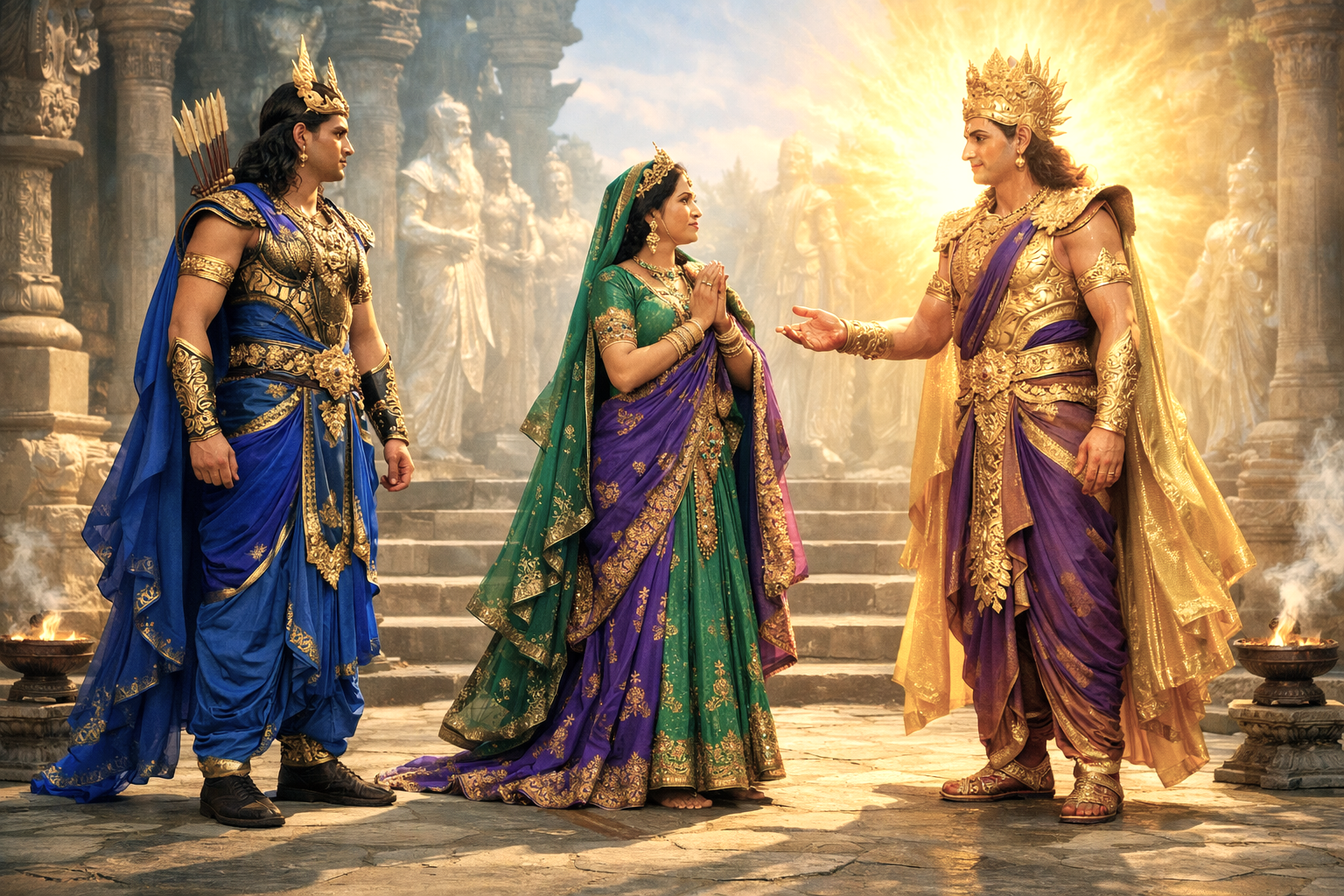
Karna's family is the most tragic and complex in the entire Mahabharata. His birth mother was Queen Kunti, and his spiritual father was the Sun God, Surya. However, he was found and raised by his loving adoptive parents, the charioteer Adhiratha and his wife Radha, which earned him the name Radheya, a title used to mock his low birth. His sworn brother and only true friend was the Kaurava prince Duryodhana. He was the unknown elder half-brother to his greatest rivals, the five Pandavas. This secret lineage placed him in a state of constant, heart-wrenching conflict between his loyalty and his blood. Karna Virtue of the Villain
The Humiliation of a Charioteer's Ambitious Son
Karna's youth was a relentless struggle against the rigid caste system that denied his talent. The childhood of Karna as a charioteer's son was defined by his burning ambition to be the world's greatest archer, and the constant humiliation he faced. He was famously denied education by the royal preceptor Drona, who taught only princes. To overcome this, he sought out the great sage Parashurama, the sworn enemy of the warrior caste. The story of Karna lying to Parashurama about his caste by claiming to be a Brahmin was a desperate act to gain knowledge, a deception that would later cost him dearly.
The Ultimate Gift of His Own Golden Skin
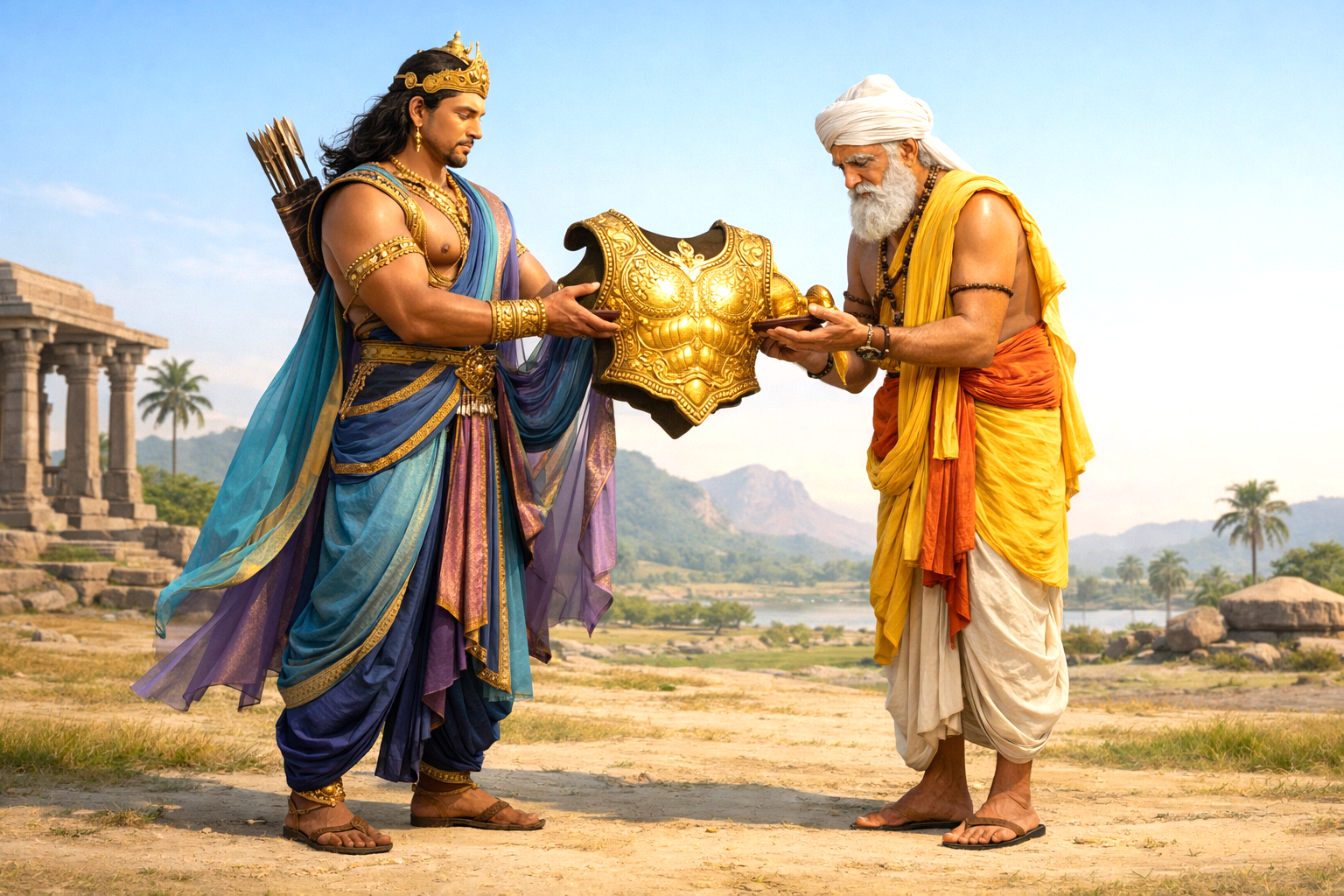
Karna’s most legendary story demonstrates his unwavering commitment to charity. The story of Karna giving away his divine armor and earrings to Indra sealed his fame and his fate. Indra, the father of Karna's rival Arjuna, knew that Arjuna could not win the war as long as Karna was invincible. Disguised as a poor Brahmin, Indra came to Karna during his morning prayers and begged for the armor and earrings as a charitable gift. Knowing it was a divine trick that would lead to his death, Karna, bound by his vow to never refuse a Brahmin, took a knife and painfully cut the god-given armor from his own flesh, cementing his legacy as the greatest philanthropist in history. Karna Virtue of the Villain
The Chariot Steered by a Demoralizing King
Karna’s divine vehicle during the Kurukshetra war was a magnificent chariot, but his charioteer was a symbol of his tragic destiny. The story of King Shalya becoming Karna's charioteer was a strategic move by the Pandavas. Shalya, the uncle of the Pandavas Nakula and Sahadeva, was tricked into fighting for the Kauravas. As Karna’s charioteer, Shalya fulfilled his duty to drive the chariot, but he spent the entire time praising Arjuna’s skill and belittling Karna’s. This constant psychological warfare, this voice of doubt in his ear, was a major factor in demoralizing Karna during his final, epic battle.
A Teacher's Curse and a Sunken Wheel
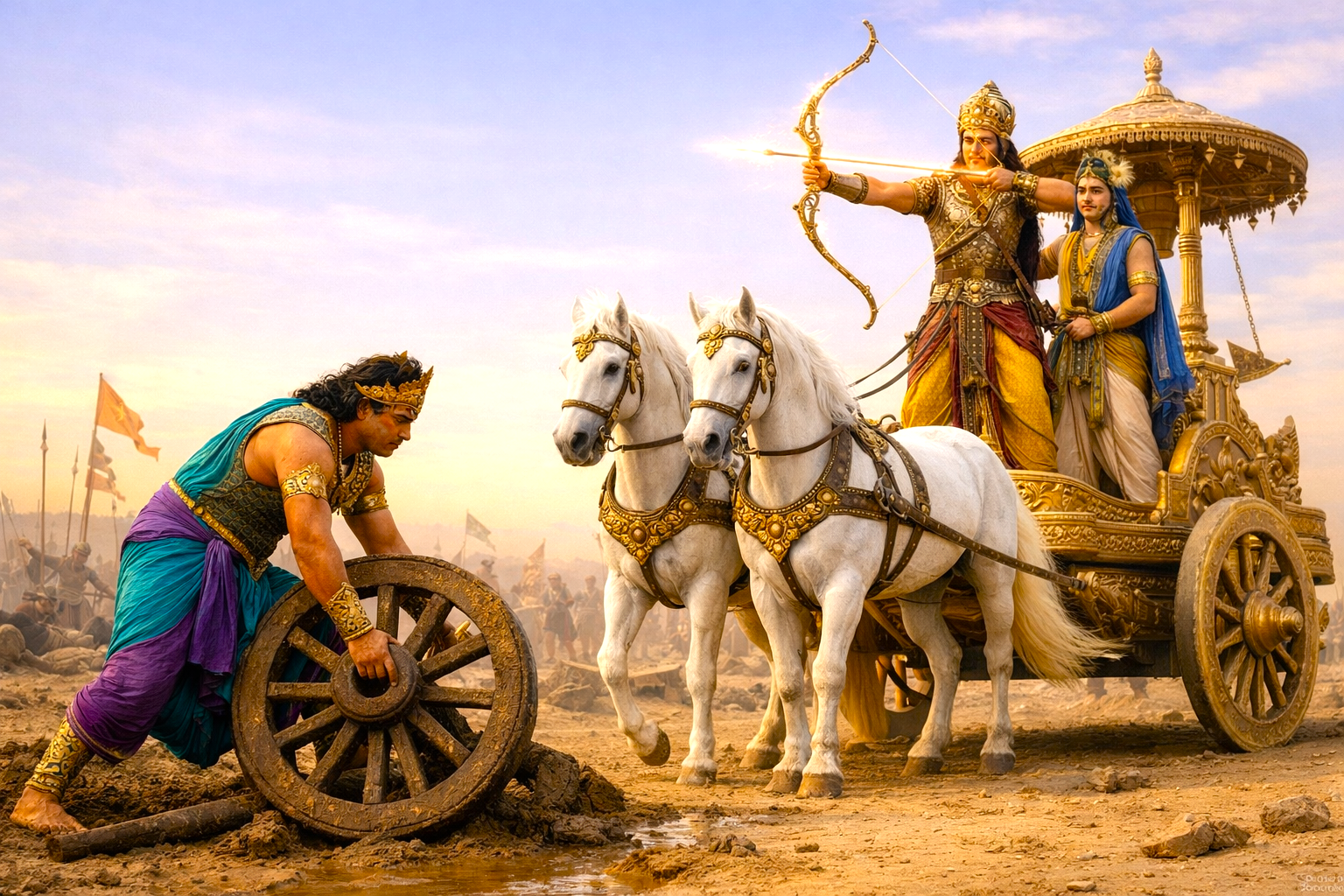
The death of Karna was not just a defeat in battle; it was the culmination of multiple curses. The story of Karna's death at the hands of Arjuna was a moment of supreme vulnerability. First, the curse from his guru Parashurama for lying about his caste activated, causing him to forget the mantra for the Brahmastra at the most crucial moment. Then, as foretold by a Brahmin he had accidentally wronged, the wheel of Karna's chariot sank into the mud, rendering him helpless. As he struggled to lift the wheel, unarmed and on foot, Krishna commanded Arjuna to fire, and Arjuna, following his duty, killed his great rival in this state of helplessness.
A Message: Your Character Defines You, Not Your Birth
Karna's tragic life is a powerful and enduring message about destiny, honor, and identity. The empowering message for humanity from Karna's life is that a person's worth and greatness are determined not by the circumstances of their birth, but by the quality of their character and the magnanimity of their actions. Despite being denied, mocked, and cursed, he rose to become the greatest warrior and the most generous soul of his time. His life is also a cautionary tale about the dangers of loyalty to a wicked friend, showing that even a noble character can be led down a path of adharma by misplaced allegiance.
The Solar Plexus and a Tragic, Golden-Red Ray
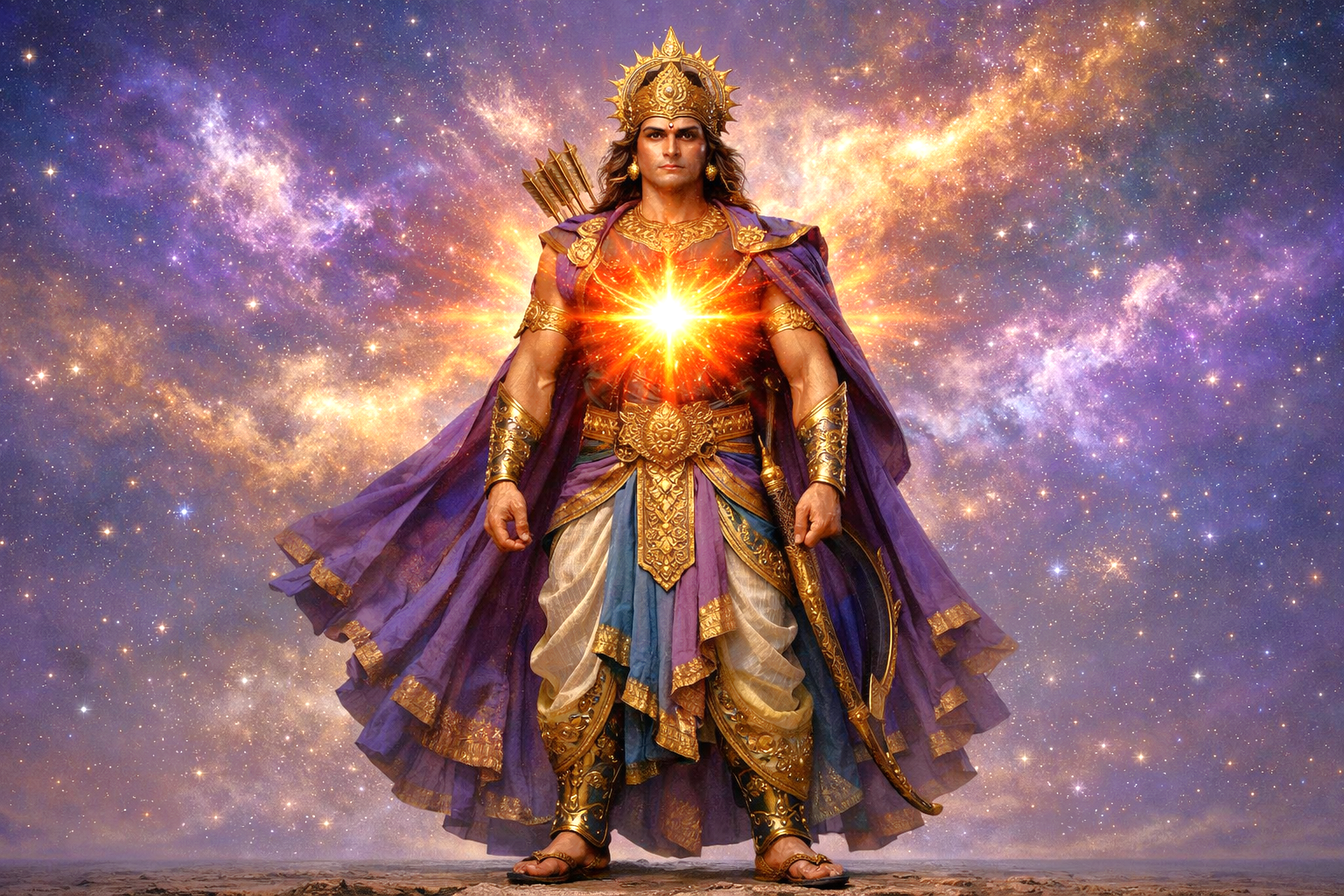
As a warrior of immense ambition and the son of the Sun God, Karna's energy is a fiery torrent centered in his will. He is a tragic embodiment of the Manipura (Solar Plexus) Chakra, the seat of personal power, ambition, and ego. The key frequency that Karna embodies is that of unrecognized solar glory and righteous pride. His auric field would be a brilliant, fiery golden-red ray, reflecting his solar parentage (gold) and his warrior nature (red). However, this light would be clouded by a persistent shadow of sadness and rejection, a glorious light forever struggling against an imposed darkness.
The Divine Bow That Conquered All Kingdoms
Besides his innate armor, Karna possessed one of the most powerful celestial weapons in the epic. The power of Karna’s divine bow, the Vijaya, was legendary. This bow, crafted by the divine architect Vishvakarma for Shiva, was gifted to Karna by his guru Parashurama. It was said that the bow was indestructible and that it ensured victory for its wielder, humming with power and making the user's arrows even more potent. It was with this Vijaya bow that Karna performed his Digvijaya Yatra, conquering all the kings of the world and proving himself to be an unstoppable force of archery. Karna Virtue of the Villain
The Sun and a Debilitated Saturn: A King's Unfortunate Life

Karna's life is a perfect and tragic astrological case study. He is the ultimate personification of the divine power of the Sun (Surya), representing royalty, honor, and brilliance. However, his entire life was lived under the influence of a powerful and debilitating Saturn (Shani), the planet of restriction, sorrow, low-status, and karmic hardship. Karna’s story is the eternal conflict between a brilliant, royal Sun, constantly being suppressed, denied, and humbled by the harsh, restrictive realities of a cruel Saturn. He was a king by birthright (Sun) forced to live the life of a servant (Saturn).
Step Inside The Story - View All Tour Itineraries & Details

We’re here to offer genuine, thoughtful guidance if your interested in travelling to India. As a small, dedicated team, we pay close attention to every detail so you can focus on enjoying the experience while we take care of the planning. We believe the best trips begin when someone truly listens to what you want and how you like to travel, so the journey feels right for you and contributes to a happy, positive group on tour. Our communication stays clear, straightforward, and respectful at every step, with the goal of helping you feel understood, supported, and confident from first contact to the end of your journey.
Click Catherine Frith - About The Founder
Click Discover Life Travel - All Tours and More
Click Why We Are Different - Unique, Safe, Transparent